Showing posts with label writing. Show all posts

Friday, 22 April 2016

Fifty Shades Of Darker Gray - when characters fight back


Marston Moor really is going to be a grim book.

(With much humour in it, but I very much fear that it will be a sort of grisly, Babbitty battlefield humour.)

Today I have been much thinking about Gray. It's no spoiler that Gray is a woman; we'd call her genderqueer now, but in the 1640s cross-dressing women were sufficient of a menace that King Charles went public about his disapproval of such wenches in the Army, issuing a proclamation in 1643 to prevent the horror of it all.

There will be probably one day be a Gray story, because she intrigues me, too, but I'm not always sure I like her, never mind understand her.

This all comes from a remark about Tom Hiddleston - an actor who's doubtless a mighty fine actor, but who doesn't float my boat - one of those daft little memes that goes "Tonight, darling, all your neighbours will know my name."

And I thought that was too funny not to use. Now, you know, Hollie - staid old married man whose idea of naked is leaving his sword on the table downstairs and whose definition of ecstasy is ember tart and Het in the same place at the same time - it's not something he'd ever say. And Luce would probably be too busy kissing his way up the inside of the lady's wrist and trying to look poetic and yearning whilst wrestling with her laces. Venning - nah, Alice would kill him. And the chances of Russell going to bed with anybody for another... well... a while, are remote: he's too scared, after the last time.

So it's going to be Gray, isn't it? It's going to be Gray, trying to demonstrate to a troop full of testosterone that she has bigger balls than they do.

The thing is, though, I was thinking about that young lady. I just can't work her out at all. She is a woman, who dresses, fights, and behaves like a man. Does she want to be a man? I'm not sure she does. (I'm not sure it would cross her mind to, either.)

Does she want to be a woman, though - I'm not sure she does that, either, and given that she is going to have a relationship with one and possibly two members of the rebel rabble, that's what I find intriguing.

And that's where I start to flounder a bit. Because imagine this: there's Gray. Young, not exactly what you'd call pretty, but in possession of all the necessary female anatomy, kicking around one of the rowdier sorts of knocking-shop with some disreputable sorts. There she is, swaggering about making slightly tipsy remarks of the nature attributed to Mr Hiddleston. This is the point at which she's going to fall into the arms of some young man who's going to make her a real woman... right?

And the answer is - no. I wish to goodness it was, but she's resisting it every step of the way. She just is not going to let me write it that way. And she's going to have her fling with one of the whores, and ... so she's going to be gay, right, and that's why she dresses as a boy, because she's some sort of butch drag queen?

And - nope, she won't let me do that, either. (She's currently glowering at me with her bottom lip sticking out like a baggage-mule's, and her eyes narrowed. Definite no, then. )

Gray's mother was raped by a soldier at the siege of La Rochelle, but I don't think that's it, I don't think she's frightened of men, I don't think she has any trauma in her past from which the right man will free her. (Don't think she's frightened of very much, actually.) And when it comes to it - so to speak - she does like sex. Though she is, very definitely, the dominant one. So to speak. And then again, possibly not.

Which leaves me with an unpalatable fact.

She's a woman, who is not motivated by "feminine" things. She's not moved by relationships, or sex, or love. She's not gay, and she's not straight either. She enjoys the physical aspects, but she enjoys them just as much with a woman as a man, and she's quite open about that.

Now I could decide that I'm going to write her differently. That I'm going to make her change, when she meets the right man: that really, she's got a heart of gold - because that'll make her nice and accessible, it'll be a nice comfortable read.

But she's not like that.
And yes, the man she marries - and she will, and if you've read all the books you know who she marries - she will break his heart. He's one of the more likeable lads of the rebel rabble and there is a strong argument that he deserves better. But does he? Or is he marrying her because he thinks, in typical cork-brained romantic style, that love will change her into someone he likes much better...?

If you work on the assumption that people in books should be real people - should be themselves, should be believable, even if that means they're not always nice, or kind, or comfortable - she's good.
But by heck, she's hard work to write as herself. 

Saturday, 5 March 2016

Meeting Old Friends in Worcester - Guest Post from Alison Stuart


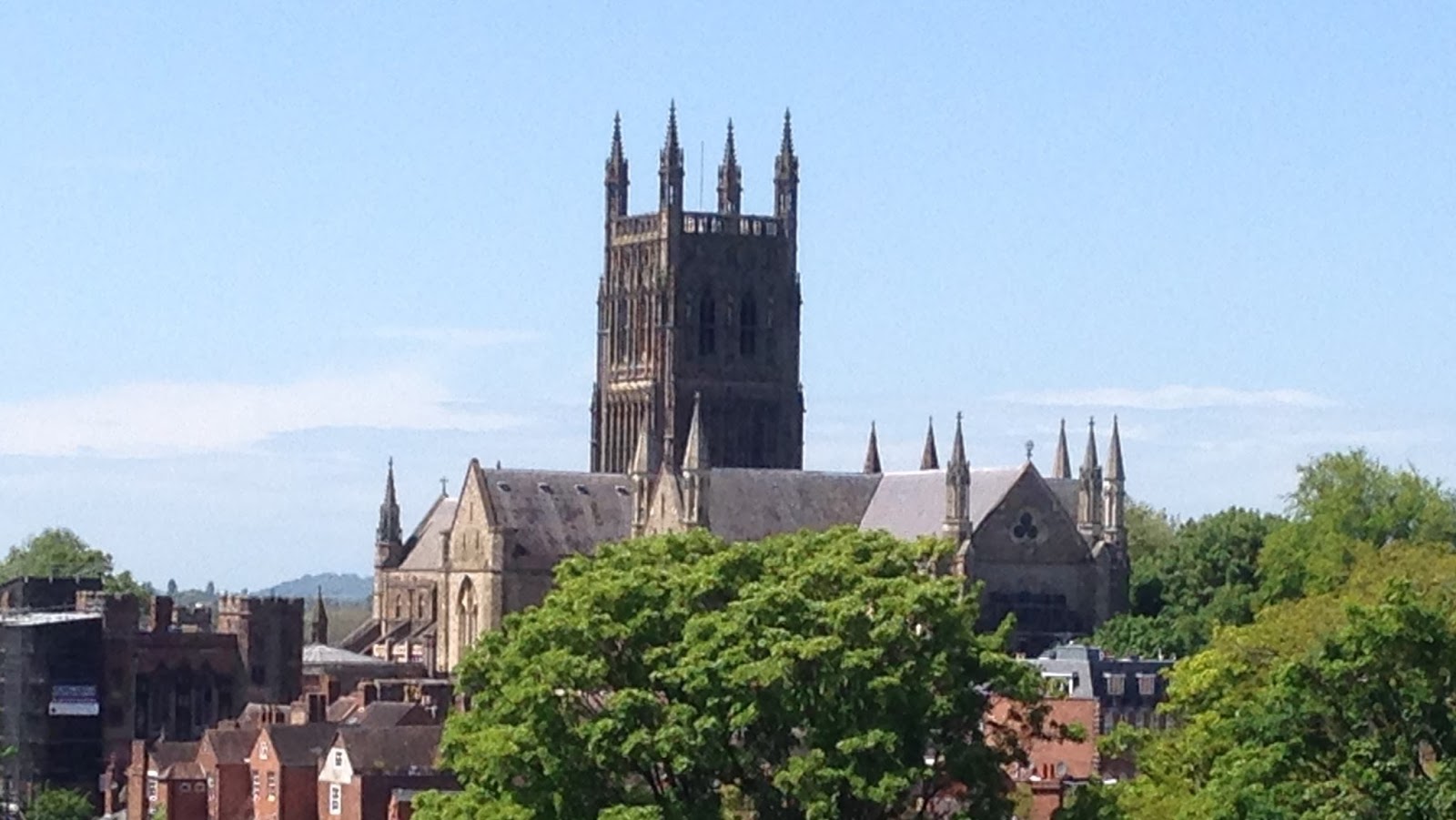
M.J. Logue’s Uncivil War series begins in the fair city of Worcester (RED HORSE), a city which saw its fair share of strife during the Civil War period, ending with the Battle of Worcester on 3 September 1651, a battle that is the starting point for my own GUARDIANS OF THE CROWN series. My latest release,  EXILE’S RETURN, marks the end of the series which spans the years of the Interregnum from 1650 to the restoration of King Charles II in 1660.

Last year I was fortunate to go back to Worcester. I say ‘back’ because, although I’m an Australian, my family has had a long, long association with Worcester, most notably boasting a High Sheriff of Worcester (my great grandfather) and a well-respected MP and County Councillor (my grandfather) and my father served under the colours of the now defunct Worcestershire Regiment.

My last visit to Worcester had been some twenty plus years ago when I was researching a little story I was writing centred on the Battle of Worcester. I wanted to write about a group of friends/comrades and what this seminal battle of the English Civil War meant to them and their families. This led to the Guardians of the Crown series.  The stories follow the lives of three young men, Jonathan Thornton (.  (BY THE SWORD), Kit Lovell (THE KING’S MAN) and Kit’s brother, Daniel (EXILE’S RETURN). To M.J. Logue’s disgust they are, I am afraid, ‘rascally royalists’. However she will understand what it is to have imaginary friends… and how very real the characters in our stories can be so it will come as no surprise to say I arranged an assignation with my characters during my visit!

We moored our canal boat below the Sidbury Lock within spitting distance of The Commandery and the site of what was once the Sidbury Gate through the walls of the old city (now long since gone). Having an afternoon free, I abandoned my travelling companions and stepped down on to the tow path of the canal (which had not been there in 1651). They were waiting for me - Jonathan Thornton, Kit Lovell and his brother Daniel, my companions from the past and they would be my guides for the afternoon.

We began with The Commandery (that was its name long before the events of 1651). In its past it had been a merchant's house, a hospital and in 1651 became the Headquarters for Charles II.
(Jonathan) attended the meetings at the Commandery and concluded the house had been wrongly named. He saw precious little evidence of command taking place within its walls...In the endless councils that took place in the hall the young King found himself assailed from all sides by conflicting advice.  .  (BY THE SWORD)

From The Commandery we set off up the hill to Fort Royal where a royalist battery had been established to defend the approach to Worcester along the Sidbury road. I won't go into the details of the battle itself (I've written about it elsewhere...click HERE). Suffice to say that while the royalists held Fort Royal, Cromwell had taken Red Hill and Perry Hill. The king himself led an attack on Red Hill but was driven back to the city. Fort Royal fell, the royalist defenders slaughtered to a man and the guns turned on the city itself.

American readers may be interested to know that it was on this hill that an oak tree was planted in commemoration of a visit by Thomas Jefferson who is quoted as reminding all Englishmen that it was at Worcester that the concept of Liberty was fought for... you can read his quote on the plaque below...

My companions led me back down the hill toward Sidbury Gate...
The Parliament guns had been brought to bear on the gate, turning the retreat into wholesale slaughter. Amidst the screaming of man and beast, the carnage of blood and guts and with shot pounding into the walls and the city, the King managed to get back through the gate. Jonathan followed through the confusion, scrambling over an overturned oxen cart to reach his King. .  (BY THE SWORD)

No trace of the gate or walls remain today (destroyed for the building of the canal in the 1760s), just one small plaque on a wall marks its existence. We turned into the city and down one of the last remaining authentic city streets - Friar Street (curse those 70s redevelopments!). Still lined with half timbered houses, it is only here one can still get a feeling for 17th century Worcester.
Wilmot pulled at Jonathan’s arm and they both ran up Friar Street, toward the King’s lodging. Jonathan took only one look back to see Giles, fighting like a virago, a small defence against the mass of red-coated soldiers who now flooded into the city from all gates except one: St Martin’s Gate stood close by the King’s lodging and remained as yet unbreached. .  (BY THE SWORD)

It was here in Friar Street that Jonathan, Giles, Kit and Daniel lodged in a house that may have looked a little like Greyfriars (now a National Trust property). Here they played cards on the night before the battle.
Another evening at the Commandery had ended in bickering and Jonathan trudged wearily back up Friar Street to his billet ... In the downstairs parlour of the large, half-timbered house, Giles played cards with Kit Lovell, who had recently rejoined them. They were both fiendish card players, with a tendency to cheat, and Jonathan declined their invitation to join them. .  (BY THE SWORD)

Further up Friar Street we came to the building now known as The Charles II house (and rather ignomiously - a pie shop) which had been the King's Lodgings and from which he escaped.
They found the King within his lodgings, watching uncomprehendingly as Buckingham burned papers on a hastily lit fire.
‘We must go, Your Majesty,’ Wilmot said.
The King looked up at his old friend and advisor. ‘Leslie will come,’ he insisted. ‘We will rally again.’
‘No, Your Majesty,’ Buckingham spoke. ‘It’s too late. Leslie has failed us, Hamilton is fallen. We must away while we still have breath in our bodies.’
The noise of the fighting, drawing closer up the street, brought the King to his feet. With the Parliament’s soldiers at the front door of the house, the King and his party left by the back. Taking the nearest horses they fled, at a hard gallop, through St Martin’s Gate, the gate that led th(e way to the north. .  (BY THE SWORD)


Finally at the great Worcester Cathedral, we took a moment to visit the tomb of bad King John (according to M.J. Logue in RED HORSE, defaced by a large, bad tempered black horse in 1642 when it was used to stable Parliamentary cavalry). The prisoners from the battle had been held in the Cathedral following the battle.

At the end of that bloody day, the King had become a fugitive in his own land and Daniel, nursing a wound to his right arm, had huddled against the tomb of King John in the great Cathedral of Worcester, a prisoner like the hundreds of others who had survived the battle. With the cold stone pressed against his face, he had hoped that no one would notice the shaming tears of humiliation. (EXILE’S RETURN)

Here we parted company, my imaginary friends returning to the past, and I trudged back through the streets of Worcester to meet my real friends at the Worcester Porcelain museum (in what had been a thriving factory on my last visit!).

About EXILE’S RETURN
The breath-taking conclusion to Alison Stuart’s English Civil War trilogy introduces a heroine with nothing left to lose and a hero with everything to gain…

England, 1659: Following the death of Cromwell, a new king is poised to ascend the throne of England. One by one, those once loyal to the crown begin to return ...
Imprisoned, exiled and tortured, fugitive Daniel Lovell returns to England, determined to kill the man who murdered his father. But his plans for revenge must wait, as the King has one last mission for him.
Agnes Fletcher's lover is dead, and when his two orphaned children are torn from her care by their scheming guardian, she finds herself alone and devastated by the loss. Unwilling to give up, Agnes desperately seeks anyone willing to accompany her on a perilous journey to save the children and return them to her care. She didn't plan on meeting the infamous Daniel Lovell. She didn't plan on falling in love.
Thrown together with separate quests – and competing obligations – Daniel and Agnes make their way from London to the English countryside, danger at every turn. When they are finally given the opportunity to seize everything they ever hoped for, will they find the peace they crave, or will their fledgling love be a final casualty of war?

If you would like to hear an excerpt from EXILE’S RETURN professionally read. Click HERE

EXILE’S RETURN is available on AMAZON, KOBO, Ibooks and all reputable ebook stores

ABOUT ALISON

Award winning Australian author, Alison Stuart learned her passion from history from her father. She has been writing stories since her teenage years but it was not until 2007 that her first full length novel was published. A past president of the Romance Writers of Australia, Alison has now published seven full length historical romances and a collection of her short stories.  Many of her stories have been shortlisted for international awards and BY THE SWORD won the 2008 EPIC Award for Best Historical Romance. 


Her inclination for writing about soldier heroes may come from her varied career as a lawyer in the military and fire services. These days when she is not writing she is travelling and routinely drags her long suffering husband around battlefields and castles.


Readers can connect with Alison at her website, Facebook, Twitter and Goodreads.


And don’t forget to enter my Guardians of the Crown contest (Closes 15 March):  click HERE

Monday, 4 January 2016

The (Public) Rights of Man. And Woman

I got my log-in details for my Public Lending Rights registration today.

Now, unless you're an author, that probably means very little to you, and if you are an author, you're probably thinking "PLR? oh crikey yes!"

Basically, I'm now recognised as an author whose work is available in libraries, and I get paid royalties for same. Which is kind of exciting, and makes me kind of sad at the same time, because there should be something more to it than an email saying that I'm now registered. I don't know, a fanfare? A raspberry? It's sort of the stamp of recognition that I am a Real Author, and holding my own against people with epic publicity budgets and dedicated PR teams. And there's me, writing like stink in the back bedroom on a laptop with most of the keys missing.

But more than that, it made me think about libraries, and other institutions that we take for granted - education, that we take for granted, and the ability to read books. I live in Cornwall, and I can't walk much more than a mile from my house in any direction without coming across one of the Passmore Edwards Institutes.
John Passmore Edwards was born in Blackwater, within walking distance from me, in 1823. He was the son of a carpenter, and like the children of many of the Cornish working poor of the 19th century, pulled himself up by his bootstraps. He became a journalist, and then a media magnate, as well as a delegate to peace processes in Europe between 1848 and 1850. However, and most significantly for me, he was also a passionate believer in the working man's right to an education; he was a generous donor to the Workers' Educational Association, and gifted libraries, schools, and art galleries for men and women whose hard working-life meant that they - or their children - did not have the luxury of access to full-time education.

I wonder sometimes if perhaps we turn full circle; if perhaps having been given the right to education, people no longer see it as a hard-won privilege, a thing that men and women fought to achieve. That to many of us now it's devalued currency, as taken for granted as our air and clean water. Two hundred years ago, my little boy would only have been going to school tomorrow if we could afford it, or if he could be spared from wage-earning labour that put food on the family table. (Yes, two hundred years ago, children were still working in mills, their nimble little fingers, speed, and small stature being valuable, and their poor little bodies being cheap to feed and dispensable.) Schooling until the age of ten was only made compulsory in 1857, and the age at which a child could leave school was only set at sixteen, in 1972.
We - people my age - we have never been part of a society in which we want to learn but are deprived by circumstance of the ability to do so. Have never, thank God, lived in a world where books are "for your betters" - not beyond the reach of poor people, or working people, or children, but are for everyone.
And, you know, maybe we need to think about that. That maybe education and literacy are still a prize, an achievement to be proud of, rather than a casual box to be ticked. That there are still places in this country where adult literacy is not universal, before we even consider that there are countries in the developing world where parents are still fighting for their children's opportunities to be educated out of poverty. We don't hold any moral high ground on literacy at all. When you think that Passmore Edwards and his like made it possible for every adult in England to access literacy and learning, the idea that there are grown men and women who have the physical and mental capacity to gain an education, and make a conscious choice to remain ignorant is rather obscene.

Books are not our friends. Books are as necessary as breathing. Not just mine, but science books - romance books - books about keeping fish, or driving test theory.

If you're reading this, it's because someone fought for your right to an education. Don't ever take it for granted.

Tuesday, 13 October 2015

The Fourth Musketeer - an interview with J M Aucoin


So tell me about your new book, and why I should immediately rush out and buy it.
Sure! Honor Among Thieves is the first book in the Hope & Steel series. It takes place during 17th Century France, a few decades after the Wars of Religion decimated the countryside and a couple decades before the famed Musketeers were formed.
Under Henry IV’s reign, France was starting to bounce back from those wars. The country was a little more stable financially and life was returning to “normal.” But Henry also really hated the Hapsburgs and dreamed of taking their dynasty down.
The decades of religious warfare also meant there were a lot of soldiers without employment. Some lacked skills for traditional working life; others just preferred to make their way with lead shot and steel, so many turned to banditry to get by.
Hope & Steel series is what happens when the bubbling political climate of early-17th Century France meets the harsh reality of a soldier’s post-fighting life. And all with a heavy dash of swashbuckling adventure.
We follow Darion Delerue, a former soldier turned highwayman, who has only two things of value—the hope in his heart and the steel at his side. We also follow Jacquelyna Brocquart, a young lady-in-waiting for the queen, who gets a rude awakening about the less than glamorous life at court. After a heist on a royal ambassador goes wrong, both Darion and Jacquelyna are thrown into a political plot to undermine the crown which could send France straight back into civil war.
There’s plenty of political intrigue rooted in historical events, intertwined with a fictional plot and fictional characters. And there’s also plenty of swordplay for readers who, like me, enjoy a little steel to warm their blood.

You've been compared to Alexander Dumas. Who are your writing heroes?
I’m pretty sure I pulled a Tom Cruise and started jumping on the couch when I originally read that comparison. Dumas is definitely one of my favorites, so I was floored to be considered in his company.
I think anyone who gets into the historical adventure genre has read The Three Musketeers. It’s a classic that really helped define the swashbuckler genre. For me, that story was very influential growing up.

I’m also a huge fan of Rafael Sabatini. Captain Blood and Scaramouche are some fantastic swashbuckling reads. Sabatini really knows how to turn a phrase. I swear he’s left none of the good lines for the rest of us poor authors.
I also love the Captain Alatriste series by Arturo Pérez-Reverte. Arturo has taken the classic swashbuckling genre and has given it a little more of a real world feel. A lot of time the swashbuckling/adventure tales tend to have happy endings, but actions have consequences in the Alatriste series. It’s fun and refreshing.
I really try to merge the high adventure and political intrigue of Dumas with the witticism of Sabatini and the realism of Pérez-Reverte. That’s what I’m aiming for in the Hope & Steel series.

Are you a swordsman who writes, or a writer who fences? And does it help?
Tough question! I think I’m equal swordsman and writer. I’ve been a huge fan of the historical adventure genre ever since I was a little lad. I used to watch reruns of Guy William’s Zorro on the Disney Channel every week. I must’ve dressed up as Zorro for Halloween for five straight years as a kid. It was around this time that I also saw Disney’s Three Musketeers adaption with Tim Curry as Cardinal Richelieu. I guess we can blame Disney for my swashbuckling obsession.

So swordplay is what turned me on to reading and writing. But it wasn’t until college that I started learning about swordplay. I started taking foil fencing classes as well as stage combat classes, so I learned both the practical and the entertainment aspects of swordplay. A little later I discovered the Society for Creative Anachronism (SCA). I enjoyed foil fencing, but being able to actually duel with folks in full period garb while using full-length rapiers and daggers really sung to the side of me that wanted to be d’Artagnan growing up.
Knowing swordsmanship definitely helps when writing swashbucklers. Readers expect a little sword play, and knowing what you’re talking about is a good thing. I’ve read some pretty atrocious swordfights written by people who don’t really understand how the sword works on even a bare basic level. Not that I really want to read (or write) a super technical fight scene either. It still needs to be entertaining and help further the story. There needs to be a balance between the realism of two people trying to skewer themselves with sharpened steel with the good ol’ fashion fun nature of what’s expected from the genre.
- my weapon of choice is a 36” munitions quality cavalry backsword, Birmingham steel. What’s yours?
I’m a big fan of my 37” Spanish Bilbao rapier. I had it custom made by Darkwood Armories, based after the sword Viggo Mortensen uses in the Alatriste movie adaption. I use it when fencing. As soon as I picked it up, I knew I had found my true blade. I do love me some backswords; I need one for my collection.
I also have a strong adoration for wheellock pistols. Those things are just works of art – from the aesthetics to the mechanics.

What are you writing at the moment?
I’m in between stories, you could say. I’m plotting out the next Hope & Steel novel and also world building for a possible fantasy series. Some fans have been bugging me about when the next Jake Hawking Adventure is coming out, so maybe I’ll add that to the queue.
Like a lot of writers, I have more ideas than time to do them all. Bah!
What are your plans for the future?
Keep writing. Keep fencing. Keep costuming.
Creating historical costumes (especially 17th Century) and cosplays is a fun hobby of mine. It sort of ties into the writing and fencing. While writing is fun because I’m creating something out of nothing, costuming is fun because I’m making something tangible and with my hands. And I get to look dashing as hell afterwards.
I’m also going through Capoferro’s fencing manual and writing up my interpretations of that, which can be read on my historical research/SCA blog for folks who are interested in the technical aspects of swordplay. My regular swashbuckling blogging can be found on my author blog.


... and finally, the importantest question....
Roundhead or Cavalier?
O0o0o0…. Tough question!
When it comes to fiction I usually like to root for the rebels. My protagonists tend to be people who like to live outside the conventional norms of society. So you’d think I’d side with the Roundheads. But I’m going to go against my own grain and say Cavalier. And I’ll say it’s because I like The Tavern Knight by Sabatini. Sir Crispin Galliard (aka the Tavern Knight) was a Cavalier.
I hope that’s the right answer and that we don’t have to fight over it. Although, if we do, I’ll go fetch my rapier! :D

Connect with J.M. Aucoin!


Friday, 2 October 2015

Fifty Shades Of..... Gender Bias and Sexuality in Historical Fiction

Isn't it reassuring to know that all those heroines of historical fiction, who found that they just weren't maternal, or meek, or submissive enough - that they identified themselves more strongly as masculine, that they cut their hair, or wore breeches, or climbed trees - they were all sweet, frilly girlies, really: because with the right man, you can get better!

Five hundred years ago - three hundred, two hundred years ago - women weren't allowed to identify with masculine gender stereotypes. We conformed, to the Gospel according to St Paul; we learned in all subjection, we were respectful, we covered our hair and our bodies as we were taught, or we paid the price of social ostracism.
You know the old chestnut of the girl who dresses as a boy to follow her soldier lover to war and bring him home safe? Don't get many of them in the 17th century. In fact, I don’t think I know of a single example of a woman who enlists as a soldier during the English Civil Wars - maybe that's because women were following the drum anyway, in the guise of camp followers, or maybe it's because until the creation of the New Model Army in 1645 no one was looking, or maybe it's because 17th century women were more than capable of fighting the good fight in skirts, viz. Lady Derby, Brilliana Harley, Elizabeth Lilburne, I'll stop now but I could keep going all night. The 17th century highwaywoman Moll Frith lived and dressed as a woman - as attested by her nickname, Cutpurse Moll - and anecdote reports that at one point she robbed Thomas Fairfax, shot him in the arm and killed two of his horses. Which must have pleased him no end…

But it's not really till the 18th century that we start to see the "mannish" woman appear - Kit Ross, who followed her man into Marlborough's Army and then decided that she quite liked the Army life and lived as a soldier for the better part of ten years, serving in two different units undiscovered; Anne Bonney and Mary Read, that pair of unglamorous pirate captains, who were as fierce and merciless as any of their masculine counterparts - what's interesting is that most of the 18th century women who disguised themselves as men disguised themselves successfully, and lived within close male communities undiscovered for long periods, but that they also were considered as equals of their male counterparts. Kit Ross was officially pensioned off, despite the discovery of her gender; Anne Bonney and Mary Read were sentenced to an equal punishment to their male counterpart, Calico Jack Rackham.

So, you know, there are hundreds of years of history of women living successfully as men, competing with men, existing forcefully in a male-dominated society. Succeeding, on their own terms, against men. (If piracy is your thing, obviously.) Being acknowledged as comrades and peers, by men. Women in Restoration England were running their own businesses, their own coffee-shops, although they weren't permitting female customers in those hotbeds of political discourse and dissent. Women in 1649 were presenting petitions to Parliament saying…"Have we not an equal interest with the men of this Nation, in those liberties and securities contained in the Petition of Right, and the other good laws of the land? Are any of our lives, limbs, liberties or goods to be taken from us more than from men, but by due process of law and conviction of twelve sworn men of the neighbourhood?"

And now, four hundred years later, we're denying this again in mainstream historical fiction.
The tomboyish heroine, that old favourite of romantic fiction, who's not satisfied by a life of conventionally girlish pleasures, and who finds freedom and self-expression as an equal in masculine company - she changes, of course, when she meets the right man. (He "makes" her a woman, as often as not. *shudders*)

All those strong women, who lived and worked and loved as women in their own right, who ran businesses and ships and companies of soldiers in their own right - they just needed a man, to make them want to give up their independence and be hobbled by skirts again?
Seriously?

I was talking to Kim Wright from the arts programme Art2Art on Swindon 105.5 FM earlier on (just thought I'd drop that one right there, me on the radio, not swearing, not once. Hardly. Much. At all) - he had the idea that this sudden gender conventionality in fiction was a reaction against women's freedoms in World War 2, where women were suddenly doing men's work, men's equals, threatening established masculine domains, and the womenfolk had to be groomed a little into getting back into their boxes after the war. And, you know, perhaps the reason for the popularity of that aggressively masculine, Chandleresque stuff was that a lot of women were comfortable within those boxes, too. 

And that's fine, if that's what works for you, but it's not right for everyone. We're still promoting the idea of binary genders - of girlie girls and butch men - and pushing the myth that if you are not a pink princess, or a brave hero, you can't have romance, you can't have adventure, you can't be successful. That to be atypical, in fiction, makes a character a curio, a freakshow. There was a Paul Verhoeven film called "Flesh + Blood" in which Rutger Hauer's mercenary band contained, amongst others, two sniggering and not always very kind best mates, who were rough and tough, who always had each other's backs, who were a pair of loutish young gentlemen always spoiling for a fight.
At the end of the film one of them is killed and you realise, by the response of the other, that these two testosterone-fuelled hooligans were a deeply loving and long-established couple.
And it's not relevant to the plot, it's just a throwaway scene where actually, these two brawling roughs are seen to have a capacity for deep emotion - but it's two men who are in love with each other. 

Does that matter? Yes. They're a pair of aggressive street bravos who've systematically gone through life as their own two-person gang, and now all of a sudden one of them is alone, and we see a vulnerable, frightened side to him. 
Does it matter that it's two men? No. Or it shouldn't. As Het Babbitt points out to Hapless Russell in "A Wilderness of Sin", "There is, in my opinion, an insufficiency of people loving each other in this world, dear. As if it were something to be ashamed of."

Takes all sorts to make a world, as they say in Lancashire, but if you're going to write, the world is at your fingertips. Women, and men, in history fought hard to live outside convention, knowing they faced exposure, ridicule, social ostracism, even death, for disclosing themselves. And they still do, we have not yet come so far. We owe it to readers to write those men and women back into historical fiction, not as plaster saints or  wayward sinners, but as real, rounded human beings. Just lke us.

Saturday, 25 July 2015

Luce's love life

Wilbrecht is five today.

It's an odd thing, being in a room full of happy, healthy, lively, noisy, well-nourished children. On the one hand, it's something like being dropped into a pan of boiling water, when you first walk through the door. Hot and well-nigh unbearable, for about thirty seconds, and then you start to become numb.

And then on the other hand, you think how very fortunate they are, and how lucky we are to have them, and what a privilege it is that the vexatious little buggers are happy and healthy.  (And that five years ago there was no Wilbrecht, and six years ago I did not imagine there ever might be.)

And, you know, I wonder what it might be like, if you were on your own - that you loved someone, maybe, but that maybe they didn't know, or that it just wasn't the right time or place to tell them - if maybe, it might choke in your throat, to see a room full of happy, healthy, bright children, and to think - I could do that. One of those screaming, laughing little whelps could have been mine. If she hadn't died. If she had known.
That everyone you knew, even the unlikely, even the plain and the unpromising, belonged. And there you were, at twenty-ish, single, a widower, someone who had known what it was to be a part of a little commonwealth, and who had lost it. Thinking, perhaps, that life was unfair, and wondering what your own children might have looked like, if you had been blessed.
If she hadn't died.

How you might have loved your never-children. Dried their tears, kissed bumps and grazes, told stories. Wiped noses. And it would have all been a kind myth, because you would have been just as cross and impatient as any other of these harrassed parents at times, but not in your never-world.

They loved their children, even in 1645.

Reckon we need to get Luce married off?


Thursday, 23 July 2015

Selby - a poll, please!

I have a certain situation, in Selby, and your opinion would be much valued.

Luce, Gray, and Russell, inside the barricades. Doing deeds of daring nefariety, if that is a word, which Hollie is going to go mental about when he finds out, but there it is.

("You did WHAT!! If you get your damn' fool self killed Lucifer your bloody auntie will never sleep with me again!")

Luce - nice young man, earnest, principled.
Gray - no principles at all but likes Luce and wouldn't want to make him sad
Russell - stark mad most of the time and nothing to lose, but essentially a decent young man

So.... having been helped by a Royalist sentry, how would you feel, as a reader, if either Russell or Gray cut the sentry's throat?

Wednesday, 8 July 2015

Babylon is Fallen, to Rise No More

Well, the good news is, I've finished the new book.
The bad news is, it is not "Babylon's Downfall" - it's part one of the road to Marston Moor, it's the battle at Selby in 1643, and it's called "The Smoke of Her Burning".

I should like to say, worry not, I am not turning into George R R Martin (tha knows nuthin', Hollie Babbitt)

But I'm not sure that I'm not.

I can honestly say no one comes back from the dead, mind, but there is a Walk of Shame, all the way from Essex to Yorkshire. Instead of the Wall I have the Ouse. I have in-fighting Babbitts, disfigured heroes (yes, Russell's back!) stern heroines, and there may even be one or two scenes of Het Babbitt without her stays on.

Game o' thrones, my lily-white backside, as Rosie would have it.
Bloody game o' commonwealths, more like it.


Monday, 8 June 2015

Babylon's Downfall - an excerpt from the new novel


 1644 - and here we are, knee-deep in Yorkshire, after the battle of Marston Moor. Having mislaid Thankful Russell, briefly, but....


The scarred lieutenant was such a distinctive figure, though, tall and straight and stiff as a sword-blade, all the time. He never slouched. He never relaxed. 
 
He was wearing an tawny silk sash, a bright, barely-faded one, and his hair was so fair it was almost white, and he wore it long and tied back, and you couldn’t miss the bugger, even from the back. Pacing - not walking, pacing, on his dignity, managing to look like a man who was braced to receive blows even when he was just picking his way gingerly across the whins a quarter-mile distant. 
 
There was little less dignified than a cavalry officer sprinting in riding boots, but it was often said of Hollie Babbitt that he had no dignity anyway, and so he sped up. Careful of outflung hands and upturned faces, with the dew wet on open eyes and open wounds – of the just cause and impediment of battle, of spent shot and dead horses. “Russell.” 
 
The lieutenant didn’t look his way. Almost under Hollie’s feet there was a groan, and he shot sideways like a startled partridge, and then Russell looked his way, and came hobbling across. Still stiff and straight and upright, but limping like a man who’d been on his feet all night and who had the blisters to show for it. “Sir.”
 
“Hapless...what the hell do you think you’re doing?”
 
Some of the corpses looked better than Russell. He stopped, and looked up with his mouth open, and blinked, and then said, “I don’t know.” Thought about a second, and then said again, sounding surprised, “I don’t know.”
 
The wounded man at his feet groaned again, a horrible, graveyard noise, and Russell yelled, “And you can shut up, as well!” And then sat down abruptly in the ditch and burst into tears.
 
Hollie’s first reaction was that he was going to laugh, and that he couldn’t stop himself. His next, thank God, was to sit in the wet moss between Russell and the casualty – whose side? Buggered if he knew, a lad with his leg broke, badly broke, under a dead horse – and what with the wounded trooper whimpering on one side and Russell whimpering on the other, he wasn’t sure where to put his sympathies first.
 
“Right,” he said firmly, because he was the senior officer here, and that meant he was in charge. “I know who you are, Russell. No introductions necessary. Who’s your mate?”
 
The wounded man was crying, now, a sort of desperate, relieved, sobbing, as if he had been afraid alone and now he had other living men about him and he could let go, a little. “You’re not dying, old son,” Hollie said over his shoulder. “Not on my watch you’re not. Hapless, have you been preaching at this poor bugger or something? What have I told you about saving souls when you’re on duty?” 
 
And Russell looked up, blinking, affronted, and swiped the back of his hand under his nose like a little boy. Which did nothing for his dignity, especially since it was the hand with the armoured bridle-gauntlet on, and it hurt. “I – you – he said – “ and then stopped, and frowned, and looked at Hollie out of the corner of his eye. “I see. You are teasing me.” 
 
Hollie nodded, and stood up, and put his hand on the lieutenant’s shoulder. “Aye. I’m teasing you. Blow your nose, and let’s get this poor sod out from under.” 
 
There were two of them, and the hurt trooper – and he was on the wrong side, he was one of Widdrington’s horse, and Hollie sat back on his heels and whistled through his teeth at that, knowing how close Widdrington’s men had been to Rupert’s troops – was starting to run a fever, after a night on the moor, and was neither use nor ornament. He did know who he was, though. His name was Will Bailey and he was Northumbrian-born and he was twenty-six and he wanted his wife, very badly. 
 
“Now you can do a bit of praying, if you like, Hapless,” Hollie said grimly. 
 
Bailey’s horse had stiffened, in the night. “How are you going to –“ Russell began, and Hollie cut him off. “Faith, sir. If ye have faith as a grain of mustard seed, ye shall say unto this mountain, Remove hence to yonder place; and it shall remove. Faith, and a musket butt, and you are going to pull like a bastard, lad. I got a bad wrist. You, on the other hand, are fit as a butcher’s dog. Now stand to, and on my command, heave like hell.” 
 
Bailey screamed like a rabbit, and even with the leverage of a musket-butt under the dead beast it was only possible to rock the horse’s bulk a finger’s breadth or more, and it was barely enough to drag the trooper a few inches. “Do it again,” Hollie said, panting, and Russell was sobbing again, because it was horrible, it was undignified and agonising and Bailey had pissed himself in his pain – 
 
It took forever. It probably didn’t, but it felt like it did. Bailey was out cold and bleeding badly, and Russell was all but useless, gone beyond shock into a shaking numbness. “He’s going to lose that leg,” Hollie said, because it needed to be said, while the Royalist trooper was unconscious. “If he’s lucky, he’ll go home. Better off with one good leg and a peg ‘un than dead in a ditch.” 
 
The scarred lieutenant was staring at his bloodstained hands. “I walked out to – to see if I might be of help.” He blinked, without his gaze shifting the once. “There are so many dead men. Colonel.” 
 
“Hollie. I can’t be arsed with colonel.”  

“Dead men. Everywhere. Dead, and dying, and hurt, and –“ And still not looking away, still looking at his blood-sticky hands. “I killed one of them. Colonel.” 
 
“Hollie.” 
 
“Me. I thought I could. I’m not sure I can. It was horrible. And what if –“  
“Russell?”  
“What if he wasn’t dead? What if he’s just lying there? With a hole in his belly – and the worms crawling in, and the –“  
“Russell.” He shook the lad, not hard, just hard enough to stop him, because thinking like that did nobody any favours. “You killed someone. Aye. You did. You’re a soldier. That’s your job. What the hell did you think, Hapless, you’d do a bit of smiting and the Lord would bear the buggers off in a fiery chariot?” 
 
And it was hard to tell with Russell, but his level brows drew sharply together, as if he was shocked, and anything that that shocked him out of that mad spiral of blame was good. “I – “ he lifted a shoulder in a tiny shrug. “Suppose I did. Rather.” 
 
“Well, that was a bit bloody stupid, wasn’t it? Hey!” Hollie could hear voices. He raised a hand. Looked down at Bailey’s limp, broken form. “Got a live one over here, lads!” He looked at Russell. Russell looked back, quite level, and quite sane.

“He’s one of ours,” Russell said coolly. “Be so good as to take him to our –“ his voice broke a little, “to Witcombe. I imagine he will be able to attend to Trooper Bailey’s hurts somewhat quicker than awaiting the attentions of the Army’s own surgeons. He has the less to deal with. Witcombe,” he said again, and they hoisted Bailey’s body onto a makeshift hurdle, “of Babbitt’s company. And should he wake – should he be afraid – tell him – tell him that Lieutenant Russell is praying for him.” His voice cracked, and he got up and fled, abruptly.

“Bloody funny lad, that one,” the soldier on the head end of the hurdle said, shaking his head. Looked down at Bailey. “You reckon he’s going to make it?”
Hollie shrugged. “Bloody will if Hapless has got anything to do with it.”

Wednesday, 3 June 2015

Restoration Revels with Russell

.... otherwise known as - yes, and what happens next??

There are times when my lads are about as far from me as Awbre-cat is. (Perhaps not... the day I find Luce Pettitt sitting in my lap with his chin resting on the space bar, there will be Words Had.)

But I tell you what, having Hapless Russell glowering at you at short range is a sobering experience.

It's a bit like this. You may - or may not - know, Russell and his sister have never got on, not since he was a little boy being brought up by Fly and her husband (badly), not since she decided after Edgehill that he was an object of pity and contempt, certainly not since she showed up at White Notley after Naseby and said - things. Bad things. She disowned him after that - as if he gave a tinker's - and they didn't set eyes on one another again.

Mind, he looks a lot less ragged, since he got married. (You didn't know Russell was married? Oh yes - well, you could have seen it coming, mind.) Had a bit of a rough patch after the Civil War, what with one thing and another, went a little bit odd - odder, then - sort of lost touch with everyone except Babbitt, acquired himself a recurring fever in Scotland under General Monck that nearly killed him, cut all his hair off, gave up caring what he looked like -
and then he got married, and, well, Mistress Russell won't put up with none of that sort of silliness, so he bucked his ideas up something remarkable.

He's got it in his head that there was something odd about his sister's death, though. And you know what Hapless is when he sets his teeth in something.

And he's not going to give over worriting at it, till he finds out.

But - sorry, Russell, old son. You've got four more Uncivil Wars books, a series of short stories, and then the Thirty Years' War stuff to wait for. (And you weren't even born then, Hapless, so just be patient!) 

Tuesday, 2 June 2015

Is History a Privilege?

I went to an event recently.
I went in an authorial capacity, and chatted to some people, and sold a few books and made a few new friends, including the very wonderful Laura Quigley, historian of Plymouth, and the equally wonderful Paul Diamond, founder of Hidden Heritage.

I was with some friends, and my husband and my little boy, in our re-enactment guise as the Napoleonic 32nd Cornwall Regiment. And there's your bit of scene-setting.

There was a group of children there, unaccompanied, unattended, who spent the whole day tearing around the venue laughing and shrieking and generally creating the sort of havoc that unattended children mob-handed with energy to burn, often create. (And, you know, there's maybe a whole other post about whether it's a good idea to get a hall full of complete strangers to babysit your children, but it won't be this one. So.)
The girls wanted to talk to us, and the boys didn't like that. All of about 8 or 9 years old, maybe a little older, and the girls wanted to ask questions or just to talk to us. One little girl kept coming back, bringing her doll's pushchair that she'd bought for £8 with her own pocket money, and she'd just stand at the table and show us her things: her doll, her plastic pirate gold coin, her pushchair. (It was a little bit broken, and one of the boys she was with kept trying to make it more broken. She said her dad had mended it last time but he might not be able to do it again, and she didn't want it to be any more broken. The small boy and I had a go at mending it. I think we did okay.)

Anyway, she thought we were fascinating. And that made me ever so sad, that she - and her friends - didn't think, "I could do that!" or "that looks interesting!" - they just didn't think of us as real people, who had real lives. Or that we were dressed as real people, who'd ever had real lives. We were like something out of a film, and we didn't have any relevance to them, although we were very glamorous and exciting.

And one of the other little girls wanted to buy a book, and that almost broke my heart, because she really, really wanted to, and how can you say "it's too grown up for you" without sounding like an absolute heel? And she didn't have enough money (although to be honest if she'd been older and asked, I'd have probably given it to her, just because I so much wanted her to have it.) She wrote a story at school. She asked me how long it took me to write a book, and I said about a year, but when I wrote a story for the small boy it was normally an hour or two, and she looked thoughtful.

See, what I found so heartbreaking was that these children - and they lived in a regeneration area, and they were clearly from families where money was tight - they wanted to know, and they wanted to ask, but they didn't think history was anything to do with them. It was a little magic circle of people, a privileged class of people - people with money, who could afford to buy books, and wear impractical clothes.
(People who make their children little wooden toy muskets, and have the time and the skill to do so.)
They didn't know how to dream big dreams, other than the wild fantasy of one day going to Legoland AND Butlins. That was the compass of that little girl's ambition. That's heartbreaking. You can be anything you want to be, in your head - a princess, or an astronaut, or a monster from space - and she wanted to go to Butlins and Legoland.

And I didn't have anything that I could do for them. I didn't have any books for little girls, that they could buy with their own money, and read for themselves, and be part of the magic circle.

That made me sad, and I'm going to do something about it.


Awarded for Excellence in Research by 17th-Century Specialists

Awarded for Excellence in Research by 17th-Century Specialists