Fair queen! When thou shall slay thy foe
With fatal dart from amber eye
When thou with honour lays him low
To submit his sorry self, or die
When gently thou with slippered foot
Will press thine enemy's neck
And make his heart thine arrow's butt
And call him at thy beck
Thy CYNICK must love from afar
Without hope of return
As distant from thee as the star
To be forever spurned
I die, pierced by Penthesilea's lance-
No wit, no hope, no charm - no chance.
Attributed. John Wilmot, Earl of Rochester (1665)
Later evidence suggests the poem was written by the little-known Parliament!entarian poet Lucifer Pettitt in an attempt to discourage Wilmot's unwanted attentions to his niece, Thomazine Russell, the "Penthesilea" of the poem.
Showing posts with label Lucey. Show all posts
Showing posts with label Lucey. Show all posts
Sunday, 14 February 2016

Sunday, 10 January 2016
The Serpent's Root - Cornwall 1646.Two months and counting....
Release date of March 21st and if you're wondering what may have befallen Hollie Babbitt and the rebel rabble since the end of "A Wilderness of Sin" - here's a taster...
“I want to go home,” Luce said dully, and turned his head on the pillow, though his eyes stayed closed. “I want to go home, Hollie.”
“Aye, I thought –“
He was mending, and his hair was lank, sticking to his forehead with sticky sweat: bless the lad, there wouldn't be a girl in Hampshire who'd look at him twice, now, but he opened his eyes then and looked up at Hollie.
"It's all right," he said, in that rusty, thready voice, strained with coughing. Closed his eyes again. "I'm sorry. I - she - I dreamed of her. Of Gray. It was nothing. The fever. I -" He trailed off, and under the blankets, his chest jerked, as if he might have sobbed. Only the once. "I almost believed it was real. That it - that she - that this was the dream, and she the reality. That I might wake and find myself at Bristol again, and be -. It was the fever. Nothing more."
"Just the fever. Aye. I know." And he wanted to do something reassuring, just a reaching out so that Luce might know that his lost girl might have faded like smoke, but that his friends were here, and real, and solid. But what comfort was that, when you had dreamed of a loss made whole again, and woke to find yourself in a lonely bed? Hollie put his hand on Luce's shoulder, and squeezed, gently. (The brat was a boy again, all skin and bone and tousled hair. That made Hollie's heart hurt, too, for the lad had no right to be so fragile.)
"Just the fever," Luce echoed. "Surely." And then he closed his eyes, and one single tear made its way from under his lashes, and slid down his face into his tangled hair. "It was a good dream, though. I wish -"
"No you don't," Hollie said, for that way lay madness.
“I miss her,” he said, as if Hollie had not spoken, and his voice was as flat as ever, as if he were talking of a skipped meal, or a forgotten engagement. “All the time, I miss her. And I do not know how I might bear it.”
And how could he answer that, without sounding as if Gray were a thing of no account? You get used to it? There will be other girls? “Yes,” he said, eventually, and hoped that was sufficient.
“She was not beautiful. I never counted her beautiful. But she was- alive, she was always so, so – she was never still, was she?” For the first time in weeks, another slow tear made its way from under his lashes, trickling down into his hair, soaking the greasy pillow. “Hollie?”
“Aye?”
Luce covered his eyes with the back of his wrist. “How do you forget?” he said, in a tiny voice.
And all Hollie could say was, “You don’t, Luce. You keep putting one foot in front of t’other. You don’t forget. But you get used to it.”
No consolation to think that after almost ten years there were still nights when he dreamed of Margriete, and still hurt to wake and find her gone. And that just for that first heartbeat, it hurt as much as it had.
“It will always hurt?” Luce said, and Hollie nodded, forgetting the lad had his eyes screwed tight shut.
“Like any other scar, brat. It will always hurt, if you get touched on it.”
“Good,” he said fiercely. “For – I c-cannot bear that she should not be here, Hollie, and yet I cannot bear to pretend she never was.” And he sat up, quite forgetting that he was supposed to be on death’s doorstep, with all his tangled dirty hair falling about his face, and he buried his face in his two hands and sobbed like a little boy, with no thought for his beauty or his dignity. “It hurts,” he wailed, “it hurts, Hollie, it hurts!”
Aye. Well. Luce had forgot his beauty and his dignity, but Hollie was reminded, suddenly, that he had a daughter. And that one day, as the sparks flew upwards, she would look to him to comfort her. It was thinking of Thomazine that he sat on the edge of the bed and put his arms round the brat, patting him gingerly on the shoulder as he wept.
“It’ll all come good, Luce,” he said, and closed his eyes and thought of Thomazine. “It’ll all come good.”
“I want to go home,” Luce said dully, and turned his head on the pillow, though his eyes stayed closed. “I want to go home, Hollie.”
“Aye, I thought –“
He was mending, and his hair was lank, sticking to his forehead with sticky sweat: bless the lad, there wouldn't be a girl in Hampshire who'd look at him twice, now, but he opened his eyes then and looked up at Hollie.
"It's all right," he said, in that rusty, thready voice, strained with coughing. Closed his eyes again. "I'm sorry. I - she - I dreamed of her. Of Gray. It was nothing. The fever. I -" He trailed off, and under the blankets, his chest jerked, as if he might have sobbed. Only the once. "I almost believed it was real. That it - that she - that this was the dream, and she the reality. That I might wake and find myself at Bristol again, and be -. It was the fever. Nothing more."
"Just the fever. Aye. I know." And he wanted to do something reassuring, just a reaching out so that Luce might know that his lost girl might have faded like smoke, but that his friends were here, and real, and solid. But what comfort was that, when you had dreamed of a loss made whole again, and woke to find yourself in a lonely bed? Hollie put his hand on Luce's shoulder, and squeezed, gently. (The brat was a boy again, all skin and bone and tousled hair. That made Hollie's heart hurt, too, for the lad had no right to be so fragile.)
"Just the fever," Luce echoed. "Surely." And then he closed his eyes, and one single tear made its way from under his lashes, and slid down his face into his tangled hair. "It was a good dream, though. I wish -"
"No you don't," Hollie said, for that way lay madness.
“I miss her,” he said, as if Hollie had not spoken, and his voice was as flat as ever, as if he were talking of a skipped meal, or a forgotten engagement. “All the time, I miss her. And I do not know how I might bear it.”
And how could he answer that, without sounding as if Gray were a thing of no account? You get used to it? There will be other girls? “Yes,” he said, eventually, and hoped that was sufficient.
“She was not beautiful. I never counted her beautiful. But she was- alive, she was always so, so – she was never still, was she?” For the first time in weeks, another slow tear made its way from under his lashes, trickling down into his hair, soaking the greasy pillow. “Hollie?”
“Aye?”
Luce covered his eyes with the back of his wrist. “How do you forget?” he said, in a tiny voice.
And all Hollie could say was, “You don’t, Luce. You keep putting one foot in front of t’other. You don’t forget. But you get used to it.”
No consolation to think that after almost ten years there were still nights when he dreamed of Margriete, and still hurt to wake and find her gone. And that just for that first heartbeat, it hurt as much as it had.
“It will always hurt?” Luce said, and Hollie nodded, forgetting the lad had his eyes screwed tight shut.
“Like any other scar, brat. It will always hurt, if you get touched on it.”
“Good,” he said fiercely. “For – I c-cannot bear that she should not be here, Hollie, and yet I cannot bear to pretend she never was.” And he sat up, quite forgetting that he was supposed to be on death’s doorstep, with all his tangled dirty hair falling about his face, and he buried his face in his two hands and sobbed like a little boy, with no thought for his beauty or his dignity. “It hurts,” he wailed, “it hurts, Hollie, it hurts!”
Aye. Well. Luce had forgot his beauty and his dignity, but Hollie was reminded, suddenly, that he had a daughter. And that one day, as the sparks flew upwards, she would look to him to comfort her. It was thinking of Thomazine that he sat on the edge of the bed and put his arms round the brat, patting him gingerly on the shoulder as he wept.
“It’ll all come good, Luce,” he said, and closed his eyes and thought of Thomazine. “It’ll all come good.”
Saturday, 26 September 2015
About Time We Heard From Luce... an interview with young Pettitt
"How are you feeling now?" I say, and
Luce looks up from under his hair and makes a noise which is, I think,
intended to express malaise.
"Horrible," he says, with heartfelt sincerity, and to prove a point, honks into an extremely sodden handkerchief, and subsides back into the warm corner of the settle by the fire with a groan. "I hate having a code."
"Mustard plaster," Hollie says from the shadows. "That'll settle what ails you, brat."
I suggest a hot toddy, and have to explain what one is, but upon explaining the combination of whisky, lemon juice and sugar, am met with a series of further groans from which I infer that both Hollie and Luce may have already entertained this suggestion on an earlier occasion. It apparently ended, on that occasion, with Luce's disclosing that his Auntie Het had something of a soft spot for one large, scruffy, russet-haired captain of horse - and the rest, of course, is history. "As well you should know, you baggage, for you set every bloody word of it down in that damned book," Hollie mutters darkly. "Every bloody word."
(I think he means "Command the Raven". And he's right, he does get sweary when he's drunk. Swearier.)
So. Yes. I'm expecting Luce to still be full of zeal and ardour for the Parliamentarian cause?
"Ye-es," he says, "well, sort of, but - perhaps not as hot as I was."
It seems Witless - Witcombe, they've got me at it, the fat lad who serves as troop surgeon, having been apprenticed to one before the war - has taken Luce on as his apprentice. Nothing too responsible, but -"I should rather mend men than hurt them," Luce says, and for the first time, he sounds grim. "It should not come to this. It should never have come to this."
"Well, we know whose door to lay that blame at," Hollie says, and Luce looks at him thoughtfully. As if he can't quite decide, two years into this most uncivil of wars.
On the other hand, Luce has seen the world. (He says ardently, and who am I to dissuade him that getting as far as Yorkshire does not constitute seeing the world? In 1644, it pretty much does, bless him.) He's seen the Humber and the Ouse, and the ships that go down to do their business in great waters - Hollie, that most notoriously appalling sailor, makes a horrible gurgling noise - eaten toasted cheese in Cheshire, ridden across Yorkshire in the dark, listened to seditious sermons in Bolton. Eaten strawberries in the Vale of Evesham and had his heart broken at Edgehill.
- it's not cured him of a degree of cork-brained romanticism, Hollie mutters.
So, you know, is there anybody special at the moment? I say. (I do get asked that quite a lot, regarding our dashing young cornet.)
Hollie makes another horrible noise. "Aye. Several somebodys."
"Shut up," he says, quite amicably, and it's rather nice to see how far they've come, in two years. That Hollie, who is neither so grizzled nor so cantankerous as he pretends to be, at thirty-six, has acquired a habit of heavy-handed playfulness, and that Luce, who was so very proper and conscientious two years ago, can now call his commanding officer an arsehole without turning a hair.
There's a smart tap at the door. "Colonel Babbitt. Sir. Company coming up the York road."
"Reckon you'd best get on, then, mistress," Hollie says, with a sigh. "Duty calls. You remember Russell?"
Of course, I say, and the scarred lieutenant gives me one quick starry-eyed glance of purest joy from under his eyelashes. He says nothing, of course. Hapless Russell has been in the throes of a crush of epic teenage proportions on one author of his acquaintance ever since she rescued him from a future of monumental boredom as the Earl of Essex's secretary. Luce looks at his friend, who is now blushing like a rose and trying to look cool and unruffled, and then at me.
"Not going to happen, Hapless," he says, with a degree of sympathy that makes me think that Luce has, somewhere, grown up. Somewhere in three books, that daft principled romantic boy has become a young man. "Come on."
"Horrible," he says, with heartfelt sincerity, and to prove a point, honks into an extremely sodden handkerchief, and subsides back into the warm corner of the settle by the fire with a groan. "I hate having a code."
"Mustard plaster," Hollie says from the shadows. "That'll settle what ails you, brat."
I suggest a hot toddy, and have to explain what one is, but upon explaining the combination of whisky, lemon juice and sugar, am met with a series of further groans from which I infer that both Hollie and Luce may have already entertained this suggestion on an earlier occasion. It apparently ended, on that occasion, with Luce's disclosing that his Auntie Het had something of a soft spot for one large, scruffy, russet-haired captain of horse - and the rest, of course, is history. "As well you should know, you baggage, for you set every bloody word of it down in that damned book," Hollie mutters darkly. "Every bloody word."
(I think he means "Command the Raven". And he's right, he does get sweary when he's drunk. Swearier.)
So. Yes. I'm expecting Luce to still be full of zeal and ardour for the Parliamentarian cause?
"Ye-es," he says, "well, sort of, but - perhaps not as hot as I was."
It seems Witless - Witcombe, they've got me at it, the fat lad who serves as troop surgeon, having been apprenticed to one before the war - has taken Luce on as his apprentice. Nothing too responsible, but -"I should rather mend men than hurt them," Luce says, and for the first time, he sounds grim. "It should not come to this. It should never have come to this."
"Well, we know whose door to lay that blame at," Hollie says, and Luce looks at him thoughtfully. As if he can't quite decide, two years into this most uncivil of wars.
On the other hand, Luce has seen the world. (He says ardently, and who am I to dissuade him that getting as far as Yorkshire does not constitute seeing the world? In 1644, it pretty much does, bless him.) He's seen the Humber and the Ouse, and the ships that go down to do their business in great waters - Hollie, that most notoriously appalling sailor, makes a horrible gurgling noise - eaten toasted cheese in Cheshire, ridden across Yorkshire in the dark, listened to seditious sermons in Bolton. Eaten strawberries in the Vale of Evesham and had his heart broken at Edgehill.
- it's not cured him of a degree of cork-brained romanticism, Hollie mutters.
So, you know, is there anybody special at the moment? I say. (I do get asked that quite a lot, regarding our dashing young cornet.)
Hollie makes another horrible noise. "Aye. Several somebodys."
"Shut up," he says, quite amicably, and it's rather nice to see how far they've come, in two years. That Hollie, who is neither so grizzled nor so cantankerous as he pretends to be, at thirty-six, has acquired a habit of heavy-handed playfulness, and that Luce, who was so very proper and conscientious two years ago, can now call his commanding officer an arsehole without turning a hair.
There's a smart tap at the door. "Colonel Babbitt. Sir. Company coming up the York road."
"Reckon you'd best get on, then, mistress," Hollie says, with a sigh. "Duty calls. You remember Russell?"
Of course, I say, and the scarred lieutenant gives me one quick starry-eyed glance of purest joy from under his eyelashes. He says nothing, of course. Hapless Russell has been in the throes of a crush of epic teenage proportions on one author of his acquaintance ever since she rescued him from a future of monumental boredom as the Earl of Essex's secretary. Luce looks at his friend, who is now blushing like a rose and trying to look cool and unruffled, and then at me.
"Not going to happen, Hapless," he says, with a degree of sympathy that makes me think that Luce has, somewhere, grown up. Somewhere in three books, that daft principled romantic boy has become a young man. "Come on."
Friday, 4 September 2015
Rosie and Tyburn. Luce and Rosa. Meet Russell's Doubting Thomas....
“Got a surprise for you, Hapless,” Hollie said smugly.
Percey had groomed the bay horse till its coat gleamed like a dark conker. He'd even acquired some chalk from God knows where and he'd whitened the gelding's stockings. There were times when you had to wonder about Mattie Percey's previous career in a stable-yard in Essex. Just how honestly he might have come by certain skills. That lad was a better painter than Lely.
What he hadn’t done was improved the big horse's temper, and it came out of the line rearing, ears pinned against its skull. Mattie had his hand gripping the bit-ring, trying to keep the horse's head down, and even so the bay nearly had him off his feet.
It was a bloody fine horse, though. Big-built, not one of your lightweight sprinters like Luce Pettitt's spindly witless Rosa: backside like a gable end and a proud arch to its thickly-muscled neck that hinted that someone might have been a little behindhand with the shears to its gelding. That was a beast that'd go all day chasing Malignants and come in at the end of it dancing. It was the sort of mount any junior cavalry officer with any dreams of a future career in the Army might covet, provided a man could train some sense into its thick head. Plenty of staying-power, plenty of fire and dash, though possibly a bit light on good humour. Hollie closed one eye and looked at the bay horse consideringly where it ramped and curvetted like some maniac heraldic emblem.
"What d'you reckon to him, then?" he said, and looked at the scarred lieutenant, expecting to see gratitude and pleasure on that cold, half-lovely face.
Instead the lad was white to the lips, the great scar on his cheek standing out a most unlovely purple, and his eyes were as mad as the bay horse's.
"Is - thish - intended to be meant in humour?" he said stiffly, and his voice had that funny slur it had when the ragged muscle in his cheek had gone stiff as wood, like it did when he was tired or ungovernable. Or drunk. That was still always a clear and present possibility.
Hollie shook his head, thinking he must have misheard, or Russell must have misheard, because –
"All right, ain't he?" Percey said happily, still being jerked around like a rag doll by the beast's flinging head, but as cheerfully good-humoured as ever he was even when his arm was being yanked from its socket by an unwanted cavalry remount. "Want to take him out, Hap- uh, Lieutenant Russell? Take a bit of the ginger out of his heels?"
"I. Should. Rather. Be. Dead," Russell said, through gritted teeth. Flung his own head up, looking not unlike the bay horse, and glared fiercely at Hollie, and Hollie would have sworn to it the lieutenant's dark eyes were brimming with wholly incomprehensible tears. "A righteous man regardeth the life of his beast: but the tender mercies of the wicked are cruel."
"What?" Hollie said blankly, and Russell snarled at him, actually snarled, baring his teeth like a dog.
"The Book of Proverb. Ss." He bit off the last consonant with a hissing, furious sibilance, and then hit himself in the temple with the heel of his hand. "Shir."
And then wheeled about and was gone, shoving Luce rudely out of the way, storming back to the house. "What," Hollie said again, shook himself, "what the bloody hell was that all about?"
"What on earth did you say to him - oh, sir, that was not well done!"
There were times when Luce didn’t half remind Hollie of Het. Well, Hollie's wife was his cornet's father's little sister, it wasn't so much of a surprise, but even so. That hurt, shocked, disappointed look was pure Het, an expression she reserved for when he did something completely stupid. What, precisely, he'd done this time, he did not quite know, save that he was still trying to make things all right for a lad who was as tricksy to handle as a barrel of rotten gunpowder, and he didn’t know from day's end to day's end what mood he was going to be on the receiving end of. Like walking on eggshells, if eggshells were volatile, suspicious, and prone to soothing their tempers by getting fiercely rat-arsed.
"What wasn't?" he said warily. "What, seriously, sir? You did not mean to be - um - funny?"
"No, of course I bloody didn't!"
Luce gave a great sigh. "Ah, God. So you - you know - did you look at the beast? Other than, um, you know - professionally?"
"What -" With one final jerk of the bit, Mattie had the bay horse with all four feet on the ground. It was still a handsome beast. It was just - odd-looking. Three white feet, and a great lopsided white blaze to its face. One blue eye, and one, slightly manic, brown one.
A perfectly sound, sturdy, fine cavalry mount, who just happened to look both ugly and irregular. It was a bloody good horse, sound in wind and limb, beautifully put together, a mount a man could rely on - could be proud of. But now Luce came to mention it, the brute did look a bit like it had been sewn together from bits of at least two other horses. Good ones, but -.
And that had been a coincidence.
"Ah," said Hollie.
The Smoke of Her Burning. October 2015.
Friday, 7 August 2015
To His Coy Mistress, Some Lines After the Battle New-fought at NASEBY
Why court'st thou death instead of me?
Why, mistress, must thou prove thy worth
By putting all thy foes to flee
Despite the virtues of thy birth?
For lady, spurn me as you must
I know and love thy bravery
That's never failed to keep thy trust
In th'face of the King's knavery
Yet may I hope, my mistress gay,
My plea your fair ear reaches:
You dress yourself in fine array
And put on skirts instead of breeches?
I dare not test, lest what I find
Is frailer yet, a bubbled glass
That shatters in a changing wind
Or withers, like the mower's grass
Yet, lady, your secret's secure
- As yet is mine: that I am yours.
If you wondered what Luce was writing during A Wilderness of Sin....
Saturday, 1 August 2015
The Smoke of Her Burning - and a bargain!

To celebrate Yorkshire Day, an exclusive cover reveal of the new book, The Smoke of Her Burning, set in Selby 1644. And to celebrate the cover reveal, the first three books in the series will remain at 99p each till the end of August! - help yourself here.
"No," said Hollie honestly, "but there is an explanation."
There's a lot of miles between Essex and Cheshire....
...and newly-promoted Colonel Hollie Babbitt is cursing the most recent additions to his company, for every step of them.
A scarred lieutenant with a death wish, and they don't call him Hapless for nothing.
Captain Drew Venning. And his dog.
Captain Penitence Chedglow, last seen smashing up the inside of Worcester Cathedral in an excess of godly zeal, and his new companion in bigotry, the silent but violent Webb.
The mysterious Trooper Gray, a one-man insurrection.
Forced to leave a posting to Cromwell's Eastern Association as a result of some more than usually scatter-brained chivalric meddling by the posh poet Lucey Pettitt, Hollie finds himself up to the elbows in freezing mud at Nantwich, mired in intrigue and insubordination.
When Hollie's old nemesis Prince Rupert relieves the siege at Newark, freeing up a cavalry force to hammer Fairfax’s garrisons in Yorkshire, it looks as if the gallant Parliamentarian defenders will be overwhelmed in the North. But after a fierce attack is repulsed, the Northern Royalists retreat to their foothold at Selby, with its vital strategic command of both the Ouse and the road to York.
It will be hard. It will surely be bloody. But Hollie’s rebel rabble may be the difference between victory and defeat for Parliament in the North.
Saturday, 25 July 2015
Luce's love life
Wilbrecht is five today.
It's an odd thing, being in a room full of happy, healthy, lively, noisy, well-nourished children. On the one hand, it's something like being dropped into a pan of boiling water, when you first walk through the door. Hot and well-nigh unbearable, for about thirty seconds, and then you start to become numb.
And then on the other hand, you think how very fortunate they are, and how lucky we are to have them, and what a privilege it is that the vexatious little buggers are happy and healthy. (And that five years ago there was no Wilbrecht, and six years ago I did not imagine there ever might be.)
And, you know, I wonder what it might be like, if you were on your own - that you loved someone, maybe, but that maybe they didn't know, or that it just wasn't the right time or place to tell them - if maybe, it might choke in your throat, to see a room full of happy, healthy, bright children, and to think - I could do that. One of those screaming, laughing little whelps could have been mine. If she hadn't died. If she had known.
That everyone you knew, even the unlikely, even the plain and the unpromising, belonged. And there you were, at twenty-ish, single, a widower, someone who had known what it was to be a part of a little commonwealth, and who had lost it. Thinking, perhaps, that life was unfair, and wondering what your own children might have looked like, if you had been blessed.
If she hadn't died.
How you might have loved your never-children. Dried their tears, kissed bumps and grazes, told stories. Wiped noses. And it would have all been a kind myth, because you would have been just as cross and impatient as any other of these harrassed parents at times, but not in your never-world.
They loved their children, even in 1645.
Reckon we need to get Luce married off?
And, you know, I wonder what it might be like, if you were on your own - that you loved someone, maybe, but that maybe they didn't know, or that it just wasn't the right time or place to tell them - if maybe, it might choke in your throat, to see a room full of happy, healthy, bright children, and to think - I could do that. One of those screaming, laughing little whelps could have been mine. If she hadn't died. If she had known.
That everyone you knew, even the unlikely, even the plain and the unpromising, belonged. And there you were, at twenty-ish, single, a widower, someone who had known what it was to be a part of a little commonwealth, and who had lost it. Thinking, perhaps, that life was unfair, and wondering what your own children might have looked like, if you had been blessed.
If she hadn't died.
How you might have loved your never-children. Dried their tears, kissed bumps and grazes, told stories. Wiped noses. And it would have all been a kind myth, because you would have been just as cross and impatient as any other of these harrassed parents at times, but not in your never-world.
They loved their children, even in 1645.
Reckon we need to get Luce married off?
Thursday, 23 July 2015
Selby - a poll, please!
I have a certain situation, in Selby, and your opinion would be much valued.
Luce, Gray, and Russell, inside the barricades. Doing deeds of daring nefariety, if that is a word, which Hollie is going to go mental about when he finds out, but there it is.
("You did WHAT!! If you get your damn' fool self killed Lucifer your bloody auntie will never sleep with me again!")
Luce - nice young man, earnest, principled.
Gray - no principles at all but likes Luce and wouldn't want to make him sad
Russell - stark mad most of the time and nothing to lose, but essentially a decent young man
So.... having been helped by a Royalist sentry, how would you feel, as a reader, if either Russell or Gray cut the sentry's throat?
Luce, Gray, and Russell, inside the barricades. Doing deeds of daring nefariety, if that is a word, which Hollie is going to go mental about when he finds out, but there it is.
("You did WHAT!! If you get your damn' fool self killed Lucifer your bloody auntie will never sleep with me again!")
Luce - nice young man, earnest, principled.
Gray - no principles at all but likes Luce and wouldn't want to make him sad
Russell - stark mad most of the time and nothing to lose, but essentially a decent young man
So.... having been helped by a Royalist sentry, how would you feel, as a reader, if either Russell or Gray cut the sentry's throat?
Thursday, 11 June 2015
Het Babbitt's Good Frumenty - Her Receipt Shar'd

"She'd see to it there was frumenty for breakfast tomorrow - a good creamy one, stiff with plums and flecked with spices - just as if both Thankful and Lucifer had been her own boys, in need of good feeding. There was always enough that she could set another place at table for her own baby nephew." - A Wilderness of Sin
Het is not entirely comfortable with this. She sees to the meals, and her dear Hollie eats what's set in front of him, being an obliging sort of husband. (And one who knows what's good for him - HB) To go around setting out her recipe for frumenty, which is a thing that everyone knows how to cook, surely - well, it's like setting out a recipe for water, dear. No one will be interested in my frumenty. Don't be silly.It's all about the wheat, you see. If you don't soak it properly and cook it long and slow you could stand for days and it would be none the tenderer. What you must do, is get the proper, husked wheat. Pearled wheat, they call it, in some places. (Sorry, dear? Yes, barley will do as well, if you must, and if there really is no good wheat to be had.)
What you must do is wash it well in fair water, to clean all the dust and husks, and then set it to boil for five minutes of the clock, and then - and only then - can you take the pot down and stand it in a bake-oven or in the hearth overnight. At Fox Barton we cree the wheat on baking-day, and set it to stand in the oven while it cools for a full day. (Failing that, boil the hell out of it for ten minutes or so, clap a lid on the pot, leave it overnight. That's the rough way. - HB)
Now, my dear Hollie would eat it exactly as it comes, with all the wheat grains burst and soft, though he does like it with milk and honey, the dear man. It sets like a jelly, and Lucifer says it does look most like frog's spawn, to which I did say, well, dear, I did not see you refuse your third helping of frog's spawn.
If you would have it the festive way - and I am told they have served it in Yorkshire this way since the Flood, with cheese and gingerbread, on Christmas Eve - then you must add a good measure of cream, and not milk. If I have all the boys to home I will put a quart of cream to the pot and stir it in well, with a good amount of honey, nutmeg, cinnamon, cloves, and one or two eggs. Some wealthy folk with nothing better to spend their money on will add raisins of Corinth, too, though they are too, too dear in this part of Essex, and dearer yet since Master Cromwell stopped their trade.
It is a wonderfully nourishing breakfast, you know, served plain, and the girls love it. And so good for the sick, being easy to digest and to prepare, and very tempting to the tender stomach. In parts of Suffolk, not to say tthe parts of Yorkshire where my dear husband saw service in the late wars, they say it has been prepared and eaten so since the days of old.
Why don't you give it a try?
Meet Het Babbitt (and Hollie, and the girls, and Luce, and all the assorted household impedimenta of a 17th century Essex household) in the Uncivil Wars books, and, most recently, in the anthology "Steel and Lace"
All profits from the book go to Great Ormond Street Hospital!
Friday, 10 April 2015
In Praise of the Plain Russet-Coated Captain (or, Why Historical Fiction Needs Anti-Heroes)
I was reading a review of a Bernard Cornwell novel this
morning and once again I am inspired to set fingers to keyboard (around the
cat, who is demanding cuddles with menaces)
As you were, gentlemen.
Once again, you see, I cannot do the dashing white knight on
his trusty steed thing.
Sharpe. Let's take Sharpe. (Please, someone, let's take
Sharpe.)
You know when you open a certain genre of book, or a book by
a certain author, pretty much to the last semi-colon what you're going to get.
You're going to get an infallible hero, who may be wrong-footed but never fail.
He will come good in the end - he will get the girl, kill the baddies, and save
the entire planet. Laughing in the face of doom, and clearing tall buildings
with one bound.
And, you know, that's kind of nice. It's all soft and
comforting and cosy. No nasty surprises.
But history is full of nasty surprises.
After the battle of Naseby, the godly Army of Parliament
hunted down and massacred over a hundred Royalist camp followers for the
unpardonable sin of speaking their own native Welsh language, and therefore
being suspected of being either whores, witches, or dangerous Irishwomen.
After the siege of Bolton, the Royalists massacred anything
between eighty and two thousand people, both soldiers and inhabitants including
women, making it reputedly the worst massacre on English soil.
That's not nice stuff. On either side.
That's not nice stuff. On either side.
My Babbitt is anything but indestructible. He spends
most of the books wrong-footed, miserable, irritated, wishing he was anywhere
else but tagging on the back of the Army of Parliament. Periodically taking a
pasting and then, being middle-aged, hurting. Not
being irresistible to the fairer sex, even if he wanted to be. Missing his wife and wanting his supper,
mostly, and wondering when he's next going to get paid. Ans how he's going to manage to run a troop till Parliament gets round to paying them.
A superhero, he is not. (He had a cape when he was
seventeen, bought for the express purpose of impressing his first wife, but he
never got the trick of not catching his sword hilt in its swirliness and
Margriete told him he looked a tit in it, so he never really took to
cape-wearing after that.)
Hollie's a decent man, fighting a war he doesn’t want for a
cause that's shafted him fairly thoroughly, and committed to it for the sake of
six troop of horse who expect him to stand their corner because he's the only
bugger stupid enough to open his big mouth in company.
Luce is a ditherer, a dreamer and a romantic. Luce is a nice
boy who ought not to be let out of the house without directions. (Luce is not,
bless him, officer material. But you work with what you got.)
Russell - well, Russell's a bipolar functioning alcoholic
with anger management issues, and certainly not someone you want to be on the
wrong side of.
The Army of Parliament had a bad habit of not winning
glorious victories. Powick Bridge - lash-up. Edgehill - no-score draw. Naseby -
not the finest moment in Parliamentarian history, gentlemen. No glittering
triumphs. No moral high ground.
No heroes. No villains.
Ordinary men - and women - on both sides, people of honour
and principle, as well as ruffians and rogues: people fighting to defend their
freedom of conscience, or just to stay alive from one week to the next. People
not too dissimilar to me and you, standing up for what they thought was fair. A
good cause, fought by good men, badly.
Now I ask you. Sharpe and his like - men of honour, or
principle? Sexy, maybe, if you like that kind of thing. Love 'em and leave 'em,
almost certainly. Daring and gallant and swashbuckling, probably.
Believable - maybe not.
Surprising, amusing, appealing, poignant, gripping - almost
certainly not.
So, meh. More people read the adventures of Sharpe et al,
knowing what they’re getting, than read the misadventures of one plain
russet-coated captain of horse circa 1643, where believe me, they do not.
Be nice if millions of people read the Babbitt books. I'd
like it. (He'd like it, the smart-mouthed Lancashire bugger. Be thrilled
to bits, he would. In a sort of not-admitting it kind of way.) But…. Would I
rather write books that make people laugh out loud on public transport, and
three chapters later make them cry?
Where people tell me off because it can’t end like that?
(Google Burford, 1649, and work it out.)
Ah, hell, yeah, I would. Because Hollie Babbitt is real.
He's all the lads in 17th century history whose names never made it into the
books, the ones that did their duty and stood their ground, that weren't
glamorous or poetic or noble or well-connected. He is what he is and God
willing, the lad will remain a joy and a sweary, scruffy, appealing maverick
from now until the end of the Civil Wars.
Thursday, 9 April 2015
A Writer's Lot Is Not A Happy One
Today, I cannot settle to writing.
There are too many little sub-plots going on in my head. I want to write the Putney Debates, where I know Hollie is going to lose his temper with the prosing and I know Russell will be hurt and humiliated. (I want to know where that one is headed, because I think there may be friendships broken at Putney, and they are characters I like.)
I want to write Ireton's wedding, which may be done as a standalone just for fun, because Het will attend that (well, dear, you couldn't expect poor little Bridget to stand up on her own in front of a room full of soldiers, could you?) Where Het goes the girls will go, and where the girls go there is often trouble, of the sort customarily engendered by toddlers.
I want to carry on with the start of the as-yet untitled Marston Moor book, which starts so horribly, and is likely to continue for a good three hundred-ish pages with brawl after brawl until the Gray/Russell dynamic sorts itself out to everyone's satisfaction. Russell is taller than Gray and considerably madder. Gray is rougher than Russell. Neither of them will back down, and both of them have their little sore points on which they cannot bear to be baited, and both of them will continue to bait each other until they've worked out who's top dog. Russell's a half-mad Puritan with a drink problem. (He drinks because it hurts, and it doesn't stop hurting, so he doesn't stop drinking. All too logical. She says ruefully.) Gray is an enigmatic little bugger with a chip on his shoulder who can't stand authority and doesn't take orders. You might wonder at this point how come Gray hasn't yet been shot or disciplined for his rebellion and there is an answer to that...
And of course it's such a lovely sunny day that I find myself sitting in the garden with a sprig of rosemary in my fingers, snuffing at the scent of clean linen and rosemary and fresh air. Thinking that even in the mini Ice Age of the 17th century, even in the middle of a civil war, surely Hollie must have got a bit of time off for good behaviour. Time to skulk off somewhere by himself for an hour with a pen and a bit of paper, and find himself a nice tree to lean up against and write letters home to his wife. (He has a habit of gnawing the end of his pen when he's thinking, and as Luce has pointed out, if it causes him that much internal anguish to set pen to paper, it can't be good for him and he ought to stop doing it.)
It won't be the good-humoured Blossom that's snuffing the back of his neck at this point, the velvety muzzle exploring Hollie's collar will still be Tyburn's. But I think for the morning, we can leave Captain Babbitt sprawling in the grass trying to edit his recent exploits so as not to scare his good lady, and sending his best love to his daughters. Luce is reading the poetry of Catullus, to the amusement of the rest of the troop.
http://io9.com/a-latin-poem-so-filthy-it-wasnt-translated-until-the-2-1589504370
(This one shuts 'em up somewhat. Um. Girly? Sorry, Luce, no offence, mate...)
And Russell? He's doing - absolutely - nothing. And he's enjoying it.
There are too many little sub-plots going on in my head. I want to write the Putney Debates, where I know Hollie is going to lose his temper with the prosing and I know Russell will be hurt and humiliated. (I want to know where that one is headed, because I think there may be friendships broken at Putney, and they are characters I like.)
I want to write Ireton's wedding, which may be done as a standalone just for fun, because Het will attend that (well, dear, you couldn't expect poor little Bridget to stand up on her own in front of a room full of soldiers, could you?) Where Het goes the girls will go, and where the girls go there is often trouble, of the sort customarily engendered by toddlers.
I want to carry on with the start of the as-yet untitled Marston Moor book, which starts so horribly, and is likely to continue for a good three hundred-ish pages with brawl after brawl until the Gray/Russell dynamic sorts itself out to everyone's satisfaction. Russell is taller than Gray and considerably madder. Gray is rougher than Russell. Neither of them will back down, and both of them have their little sore points on which they cannot bear to be baited, and both of them will continue to bait each other until they've worked out who's top dog. Russell's a half-mad Puritan with a drink problem. (He drinks because it hurts, and it doesn't stop hurting, so he doesn't stop drinking. All too logical. She says ruefully.) Gray is an enigmatic little bugger with a chip on his shoulder who can't stand authority and doesn't take orders. You might wonder at this point how come Gray hasn't yet been shot or disciplined for his rebellion and there is an answer to that...
And of course it's such a lovely sunny day that I find myself sitting in the garden with a sprig of rosemary in my fingers, snuffing at the scent of clean linen and rosemary and fresh air. Thinking that even in the mini Ice Age of the 17th century, even in the middle of a civil war, surely Hollie must have got a bit of time off for good behaviour. Time to skulk off somewhere by himself for an hour with a pen and a bit of paper, and find himself a nice tree to lean up against and write letters home to his wife. (He has a habit of gnawing the end of his pen when he's thinking, and as Luce has pointed out, if it causes him that much internal anguish to set pen to paper, it can't be good for him and he ought to stop doing it.)
It won't be the good-humoured Blossom that's snuffing the back of his neck at this point, the velvety muzzle exploring Hollie's collar will still be Tyburn's. But I think for the morning, we can leave Captain Babbitt sprawling in the grass trying to edit his recent exploits so as not to scare his good lady, and sending his best love to his daughters. Luce is reading the poetry of Catullus, to the amusement of the rest of the troop.
http://io9.com/a-latin-poem-so-filthy-it-wasnt-translated-until-the-2-1589504370
(This one shuts 'em up somewhat. Um. Girly? Sorry, Luce, no offence, mate...)
And Russell? He's doing - absolutely - nothing. And he's enjoying it.
Wednesday, 8 April 2015
SIX THINGS YOU DIDN'T KNOW ABOUT MY WRITING
…. I was challenged to seven, but I already admitted to one!
1) I don't write sequentially. I have a habit of writing a
vignette in my head, and then another, and then another, and then putting them
together like a rather badly-strung length of pearls.
This does rather mean that I have to keep rewriting the end
of my novels but calling the Uncivil Wars books character-led is a bit like
saying that water can be a little bit wet at times.
2) I have no idea what Hollie Babbitt looks like. Actually
that's not true, I know what he looks like, I just don't know who he
looks like, other than himself. I have read a number of books where characters
are evidently based on actors. Mine are not amongst them. In an ideal world, I
would cast Christopher Eccleston c. "Jude" as Babbitt, and it'd be
close, but it wouldn't be quite right. Orlando Bloom in his Legolas moments for
Luce, again not absolutely right, but as near as I can get it, and Julian Sands
(when he was young and pretty) as Russell. It's not spot-on, but it's close.
Stephen Fry has been suggested for Drew Venning…. Right
accent, wrong colouring.
On the other hand, I have no problem at all casting Tyburn!
3) I know what happens at the end of the series and I'm not
telling. The actual ending has never changed. It's already been written, and
everything else is just working up to that point. Which is not to say that
Hapless Russell will not get his own series, and that there isn't a Thirty
Years' War series on the blocks. (Is that a spoiler? Only if your chronology is
off-cock. Our Hollie is thirty-four at the beginning of the English Civil War
and went out to the Low Countries as a big fifteen year-old with an attitude
problem. That's twenty years of learning his business, by my reckoning.)
I didn't start the Uncivil Wars books with the intention of
involving Hollie in Leveller politics. It just sort of happened that way. He
started off being absolutely partisan and then it just got personal, the more
he put down roots in England again. He is not, absolutely not, any kind of
political statement. Someone did suggest that he was and I would like to set it
down - really, absolutely, categorically - that Hollie Babbitt is not any kind
of political metaphor. He is his own dear bad-tempered self and his involvement
in the Leveller movement is purely an emotional response to the treatment of
his own soldiers by Parliament.
4) I don't think I write like anyone else. Possibly Simon
Scarrow, whom I quite like. The thought of Rosie and Luce as the Civil War Maco
and Cato - hmmm. Certainly sufficiently sweary. Possibly slightly more
political, especially as the series progresses. With more poetry. I have to
admit to a near-heretical loathing of "Three Musketeers" soundalikes.
I struggle horribly with Alatriste, although cannot guarantee that someone very
like him does not stray across the radar of a young Hollie Babbitt. Hollie
(drunk on his sixteenth birthday at Breda, natch) offered to punch him
repeatedly in the head. I believe he took exception to the Spanish gentleman's
facial hair. Being a redhead, he never has succeeded with the fashionable
moustache thing. Rather a tragedy for him, in the elegantly goatee'd part of
the seventeenth century…
Anyway. I hate all that mannered thee's and thou's and have
at thee, varlet, stuff. The seventeenth century was the golden age of the
English language, undoubtedly. Let's not forget it was also funny, filthy, and
accessible. People spoke in it. To each other. They didn’t order their ale in
rhyming quatrains. (Apart from Lucey Pettitt, probably, and I imagine even he
only does it when egged on by his mates, or drunk.)
5) I have always written. The first thing I ever wrote was a
Sherlock Holmes story, aged about four, and all I can remember about it was
that it involved a graveyard at the full moon. Unfortunately it was written in
the back of the car on my way to a family holiday and I get car sick. I don't
remember the end…
Hollie and Luce, on the other hand, first appeared in a
time-travel comedy romance co-written with a friend of mine, sadly lost to
posterity, in which the gallant Captain Babbitt began as a stern and
easily-shocked Puritan officer in the Army of Parliament who was repeatedly
seduced in some very unlikely environments by a most unwomanly miss.
Luce was a very camp transvestite who desperately wanted to
get into the twenty-first century because he could wear make-up to work and no
one would pass remarks.
There was a full-length novel written about this foolery
(and a horse called Bastard who had a habit of widdling contemptuously on
people he didn’t like) but it sadly did not survive a computer crash. It was
hellish funny, though.
6) I have a habit of writing longhand on public transport,
which is where I do most of my background thinking. There is a pink notebook
which contains some very, very intimate information on the matter of the
private lives of my lads.
Not all of it will ever make it into the books…
Friday, 3 April 2015
Wednesday, 1 April 2015
A Little Commonwealth - some thoughts on romantic fiction

I hate genre romantic fiction and I can't write it
There, it's said. I joke about it but I was once signed off
work for a month with whiplash, and amused myself by reading the entire canon
of A N Other writer of Regency romance. (Who will remain nameless.) The first
one, I thought, what a hoot, fluff, frolics and frocks. The second one I was
starting to know what was coming. By the third one I was actually rather
scared.
See - and this is me being serious - though a straight down the line Dissenter and thoroughgoing Independent, with (dare I say) atheistic leanings, I am increasingly inclined
to agree with the Puritans' view of marriage, to wit, it's all about
companionship and affection and mutual respect. Genesis 2:18 - And the Lord
God said, It is not good that the man should be alone; I will make him an help
meet for him. Since sexual intimacy in marriage was part of God’s
plan for man before the Fall, it could not be less so following the Fall, and
therefore sex within the confines of a loving relationship was not the ultimate
transgression that caused man's expulsion from the Eden.
And this book - these books - portrayed relationships about
as far from companionable, equable, loving marriages as my cats are from bars
of chocolate. Brave, feisty, innocent heroine meets arrogant, tortured,
handsome hero with a dark past. Misunderstanding in which hero thinks heroine
is more experienced than she is and treats her with sexual contempt. Heroine
falls in love with this pillock in spite of the fact that she is fully well
aware that he's a toe-rag. Misunderstanding upon misunderstanding, at the end
of which tragedy of errors even hero realises that he's a bloody idiot, does
the decent thing and falls in love with the heroine. The End.
That appalled me. Because there is a whole genre of these
books, these peddlings of the Cinderella myth - that love is all about passion conquering
all, that sexual desire is the be-all and end-all of a relationship, that a man
(and it's almost always a man, as if, poor things, they are little better than
beasts driven at the mercy of what my mother discreetly used to call their
"urges"...) if he really loves a woman should be made unreasoning by
violent passion.
I think I can safely say that my Hollie desires his wife.
(Makes no secret of it, the libidinous creature, but then after several months
apart, she rather misses having her bed warmed by that lolloping great object
as well.) Would he ever be driven to lay ungentle hands on her, shout at her,
abuse her in a jealous rage? Would he bloody hell as like. I think - I hope
- that there has never been any dramatic will-they won't-they tension about the
relationship of Het Sutcliffe-as-was and her gallant captain. They meet. They
like each other. After a while, they love each other. And isn’t it that way for
most of us? We meet someone, we like them, one day we wake up and realise that
we love them, want to spend the rest of our lives with them. We don’t want to
hurt them, or frighten them, or control them, or humiliate them.
And yet we encourage our fictional heroes to be emotionally
retarded - to be abusive. To commit acts of sexual violence on women. The
number of "forced" kisses and torn gowns I've come across in that
certain genre, defies belief. It's a funny thing, but I'm in a line of business
where I work with victims of crime. Dealing with a young man at the moment
who's come my way because he "forced" himself on a girl. He didn't
rape her, didn’t hurt her physically, but frightened her and distressed her: he touched her in places she did not want to be touched. In
certain books, if he'd been a strong, silent alpha-male, that would be her fault,
you see - that the strength of his desire was such that he just had to have
her. That she encouraged him, led him on. It's a compliment, girls. Did you not
know that you only have to leave the house for those poor lust-maddened menfolk
to be tearing at your clothes, such is the power of your womanhood?
That's not emancipation, that's just tricking out an old
whore in new paint, and calling it escapism. And life throws up enough intrigue
and uncertainty, without a need to invent some more.
I leave you with a quote from the 1598 "Godly Form of
Household Government", by Robert Cleaver -
"Matrimony, is a lawful knot, and unto God an
acceptable yoking and joining together of one man, and one woman, with the good
consent of them both: to the end that they may dwell together in friendship and
honesty, one helping and comforting the other, eschewing whoredom, and all
uncleanness, bringing up their children in the fear of God: or it is a coupling
together of two persons into one flesh, not to be broken, according unto the
ordinance of God: so to continue during the life of either of them."
Take out the religious references, if you like. But - to
dwell together in friendship and honesty, one helping and comforting the other?
In all honesty, can you see Christian Grey and Anastasia in
twenty years' time, one helping and comforting the other?
Because I'm damned if I can.
Saturday, 21 March 2015
WORLD POETRY DAY - the posh poet goes for it....
SOME LINES by CAPT. A VENNING'S DOG TINNERS
ON the DEATH of PRINCE RUPERT'S DOG BOYE at the RECENT BATTLE OF MARSTON MOOR
ON the DEATH of PRINCE RUPERT'S DOG BOYE at the RECENT BATTLE OF MARSTON MOOR
O shagg'd cavalier! No more to begg,
To fetch, or steal a bone -
The noblest of Prince Rupert's trayne
Doth lie here overthrown.
For all thy pride and high degree
Brave Cur, now thou hast had it
Cut down in thy prime of life
By, likely, Hollie Babbitt.
Yet, Boye, mind well, thou proudest Dogg
That ever tupped a bitch
The paths of glory do but lead
Into a Yorkshire ditch.
To fetch, or steal a bone -
The noblest of Prince Rupert's trayne
Doth lie here overthrown.
For all thy pride and high degree
Brave Cur, now thou hast had it
Cut down in thy prime of life
By, likely, Hollie Babbitt.
Yet, Boye, mind well, thou proudest Dogg
That ever tupped a bitch
The paths of glory do but lead
Into a Yorkshire ditch.
Friday, 20 March 2015
Thankful Russell - in hiding till "Poldark" finishes
Experts reveal the historical hunk that makes women swoon
"You're putting me on," Hollie Babbitt says faintly. "For sure?"
Russell does not look flattered. Russell, in point of fact, looks scared witless. "You have a look," he says, in a very odd voice. Hollie looks up and raises an eyebrow. "Russell, what you talking like that for? With your mouth shut?"
The scarred lieutenant points. (That damned Amazon female. She has a habit of passing her ill-conceived and unwomanly pamphlets of seditious literature by Russell, and she knows what it does to him.)
"Seductive smile," Hollie reads, with mild disbelief. "What, him? That bugger was in my troop and I'd have him buck his ideas up, for sure. Running round half-dressed, he'll catch his death of cold. Small, straight incisors -" he pokes his own straight teeth with a thumb, and then looks at Russell in the manner of a man assessing the age of a horse. "Well, you do have all your own teeth, Hapless. That is true. And they are, surely, straight. Though I wouldn't call you seductive. You don't do much for me, anyway."
This is evidently of little consolation to Russell, who keeps his mouth firmly closed over admittedly-good teeth and looks quizzical.
"Manly," Hollie goes on, "but not too muscular." That leaves him somewhat at a loss. "You know a lot of fat cavalry officers?" he asks the ceiling. "- all right, Venning's built on the perpendicular, but even he's not fat. Say square, rather. Hapless, you want to have a word with that lass of yours. What is this rubbish? Manly - well, aye, we are, for the most part, fellers, yes. With one or two significant exceptions." He glowers at Luce, who ignores him. Old news. "And not too muscular. Well, that's three of us in this room who are masculine by gender and all of -"
"Slight," Luce prompts.
"Elegant build," Hollie corrects him, with a sidelong glance at Russell's lithe and greyhound-lean person. Russell - still with his mouth closed - says nothing, but tries to look untidy.
"Pert posterior."
"Oh God," Russell says faintly. He is, after all, a cavalry officer. Most gentlemen with a deal of acquaintance with horses have -
"Calluses on their arse," Hollie adds. "What kind of lass is this anyway, goes around assessing men by the quality of their backsides?" He - a married man of several years' standing - looks up in indignation. His two junior officers are looking distinctly dreamy. "I wouldn't mind?" Luce says hopefully.
"Aye, and you probably do look good in a frock, brat. The hell is this, Hapless? Oh - frock coat. What's one of them?" He almost throws the pamphlet at Russell and then goes back to it. (They are strangely addictive, these things.) "Plain soldier's coat not good enough for these wenches, is it not? Bloody soft-handed womanish - thing - look at the bloody state of him. Flailing about in the water like the Lord had meant him to be a bloody fish. Wouldn't know proper soldiering if it bit him in the ar- back of the leg." Hollie scratches at three days' worth of ruffianly cinnamon stubble. "Too clean by half, that boy. Give me a week with him and I'd make a bloody trooper of him, you see if I wouldn't."
An accent, apparently. This paragon has to have a deep, gravelly voice. Luce the Essex boy looks relieved. Russell with his soft Buckinghamshire burr, and Hollie the North Countryman, exchange a horrified glance. Luce gets up and peers at the inflammatory pamphlet. "And long hair, apparently," he says. "How fascinating."
Hollie shifts in his seat, awkwardly, touching the thick russet ponytail that hangs straight down his back. And Russell - thick fair hair worn loose, most of the time, just past his shoulders. It covers the -
"Scar," Luce says. "Good lord, Thankful. Apparently this gentleman was badly scarred in the face as a young man in the wars in Spain. They say it's most appealing to the ladies."
It's not helping, of course. The fact remains, no matter how many of the traits the experts deem so desirable may happen to be possessed by Russell, the scarred (and not unhandsome) lieutenant remains unconvinced. And, possibly, therein lies his appeal. He thinks it's all cobblers. Funny, but cobblers.
Hollie's married, so he doesn't care, although he folds up the inflammatory pamphlet to show Mistress Babbitt. He happens to share many of these desirable traits, and he'd like to confirm his good lady's agreement with same.
Luce? Well, Luce is - currently - single, and ready to mingle. He pulls the cord loose that binds his own fair hair neatly back, and wonders if a shaving-cut from this morning counts as a fabulous flaw....
"You're putting me on," Hollie Babbitt says faintly. "For sure?"
Russell does not look flattered. Russell, in point of fact, looks scared witless. "You have a look," he says, in a very odd voice. Hollie looks up and raises an eyebrow. "Russell, what you talking like that for? With your mouth shut?"
The scarred lieutenant points. (That damned Amazon female. She has a habit of passing her ill-conceived and unwomanly pamphlets of seditious literature by Russell, and she knows what it does to him.)
"Seductive smile," Hollie reads, with mild disbelief. "What, him? That bugger was in my troop and I'd have him buck his ideas up, for sure. Running round half-dressed, he'll catch his death of cold. Small, straight incisors -" he pokes his own straight teeth with a thumb, and then looks at Russell in the manner of a man assessing the age of a horse. "Well, you do have all your own teeth, Hapless. That is true. And they are, surely, straight. Though I wouldn't call you seductive. You don't do much for me, anyway."
This is evidently of little consolation to Russell, who keeps his mouth firmly closed over admittedly-good teeth and looks quizzical.
"Manly," Hollie goes on, "but not too muscular." That leaves him somewhat at a loss. "You know a lot of fat cavalry officers?" he asks the ceiling. "- all right, Venning's built on the perpendicular, but even he's not fat. Say square, rather. Hapless, you want to have a word with that lass of yours. What is this rubbish? Manly - well, aye, we are, for the most part, fellers, yes. With one or two significant exceptions." He glowers at Luce, who ignores him. Old news. "And not too muscular. Well, that's three of us in this room who are masculine by gender and all of -"
"Slight," Luce prompts.
"Elegant build," Hollie corrects him, with a sidelong glance at Russell's lithe and greyhound-lean person. Russell - still with his mouth closed - says nothing, but tries to look untidy.
"Pert posterior."
"Oh God," Russell says faintly. He is, after all, a cavalry officer. Most gentlemen with a deal of acquaintance with horses have -
"Calluses on their arse," Hollie adds. "What kind of lass is this anyway, goes around assessing men by the quality of their backsides?" He - a married man of several years' standing - looks up in indignation. His two junior officers are looking distinctly dreamy. "I wouldn't mind?" Luce says hopefully.
"Aye, and you probably do look good in a frock, brat. The hell is this, Hapless? Oh - frock coat. What's one of them?" He almost throws the pamphlet at Russell and then goes back to it. (They are strangely addictive, these things.) "Plain soldier's coat not good enough for these wenches, is it not? Bloody soft-handed womanish - thing - look at the bloody state of him. Flailing about in the water like the Lord had meant him to be a bloody fish. Wouldn't know proper soldiering if it bit him in the ar- back of the leg." Hollie scratches at three days' worth of ruffianly cinnamon stubble. "Too clean by half, that boy. Give me a week with him and I'd make a bloody trooper of him, you see if I wouldn't."
An accent, apparently. This paragon has to have a deep, gravelly voice. Luce the Essex boy looks relieved. Russell with his soft Buckinghamshire burr, and Hollie the North Countryman, exchange a horrified glance. Luce gets up and peers at the inflammatory pamphlet. "And long hair, apparently," he says. "How fascinating."
Hollie shifts in his seat, awkwardly, touching the thick russet ponytail that hangs straight down his back. And Russell - thick fair hair worn loose, most of the time, just past his shoulders. It covers the -
"Scar," Luce says. "Good lord, Thankful. Apparently this gentleman was badly scarred in the face as a young man in the wars in Spain. They say it's most appealing to the ladies."
It's not helping, of course. The fact remains, no matter how many of the traits the experts deem so desirable may happen to be possessed by Russell, the scarred (and not unhandsome) lieutenant remains unconvinced. And, possibly, therein lies his appeal. He thinks it's all cobblers. Funny, but cobblers.
Hollie's married, so he doesn't care, although he folds up the inflammatory pamphlet to show Mistress Babbitt. He happens to share many of these desirable traits, and he'd like to confirm his good lady's agreement with same.
Luce? Well, Luce is - currently - single, and ready to mingle. He pulls the cord loose that binds his own fair hair neatly back, and wonders if a shaving-cut from this morning counts as a fabulous flaw....
Tuesday, 17 March 2015
By! It's either a feast or a famine....
(As the lovely Hollie would say, being a North Country boy, and prone to such peculiar expressions.)
Three people are going to be very fortunate - my rather elegant new cover!
Three people are going to be very fortunate - my rather elegant new cover!

Monday, 16 March 2015
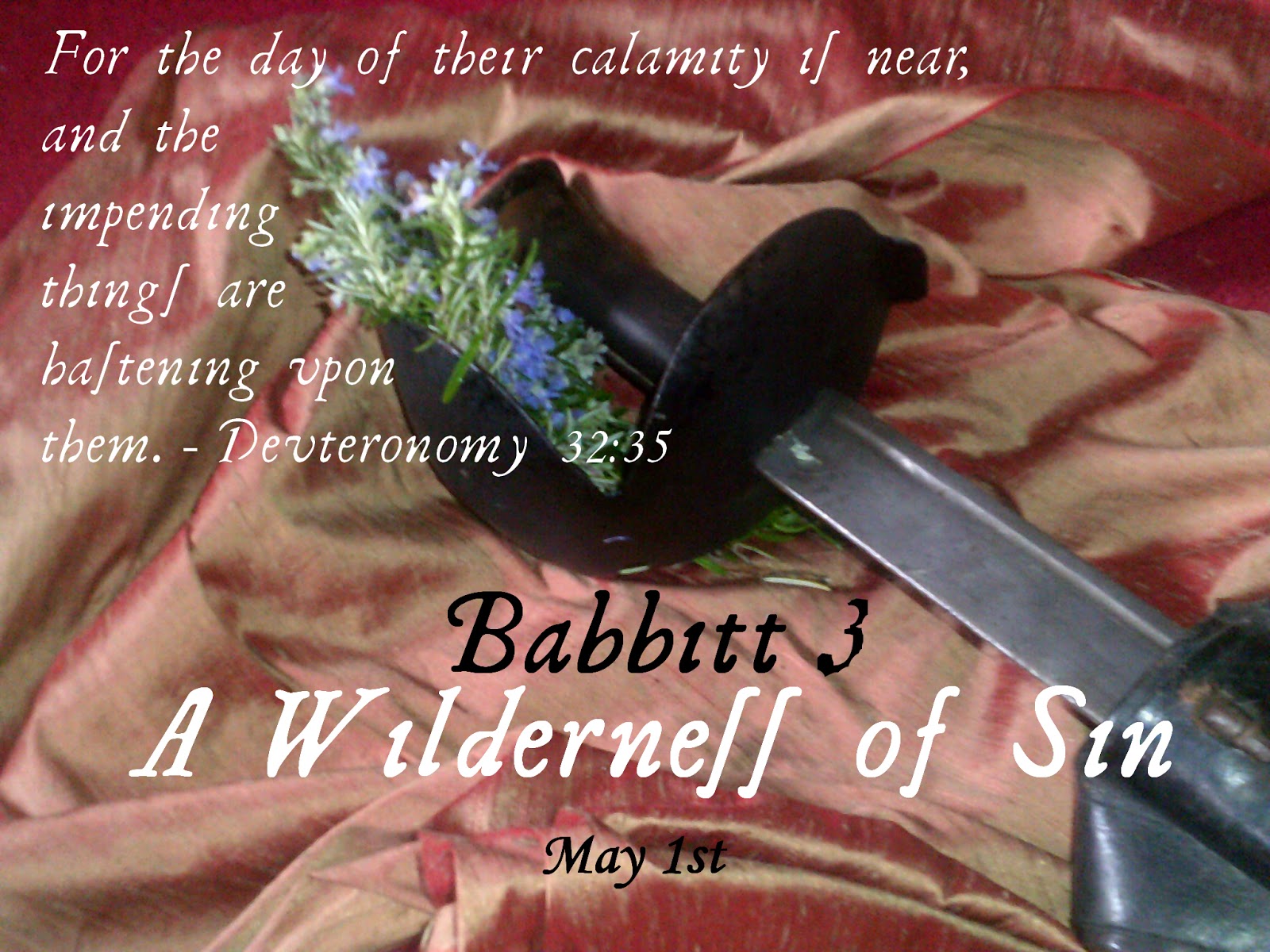
A Wilderness of Sin - available for pre-order (and the first chapter for your delight and astonishment)

Naseby, Northamptonshire
June 1645
It was a pale pearl of a
midsummer dawn, and Thankful Russell looked like a dead man.
Sitting on
his bed, he looked fragile and very, very young. As well he might. He'd turned
twenty-one two weeks before the battle at Naseby. He was twenty-one, poor
bugger, and as of three days ago, he was blind.
It had been an accident, or a
case of mistaken identity, or something of the sort that inevitably happened to
Russell. It hadn't even been during the battle. Colonel Hollie Babbitt hadn’t
got to the bottom of it, didn't want to get to the bottom of it. Thank God, he
had spent most of that particular sickening low point in the trajectory of the
New Model Army, laid out cold in a churchyard in the nearby village of Marston
Trussell, perfectly, and literally, unconscious of the vile massacre being
enacted by men he'd fought shoulder to shoulder with. His own troops. One
of the troops under his command, at least. Hollie had been endeavouring to
stand between the ravening ranks of the godly, hellbent on unjustified revenge,
and those poor bloody brave, stubborn, doomed camp-followers. One of the women
had had smacked him in the side of the head with a griddle. Collapse, as Lucey
would put it, of stout party. It had done no good in the end, either. There'd
been over a hundred of those poor women dead or mutilated - hacked apart by
good Parliament men. And there had been nothing Hollie could do to stop it.
Whatever Russell
had been doing to stop it, he ought not to have, because it had ended with
him shot in the head, not to say having been, by the look of him, very badly
beaten. Sitting upright on his bed after three days unconscious, Russell was a
horrible sight, and he hadn’t been that lovely before. The scarred
lieutenant had a stunning black eye, and a series of clotted, black gouges torn
into the cheek that wasn't already marred: his mouth was swollen and torn, and
there was old, dry blood on his top lip and his chin. The funny thing was, the
pistol ball had only grazed his skull - the troop bonesetter had taken it out
from under his skin with no trouble at all. Hollie had always said Russell had
a thick head, and now he had actual, slightly-flattened, lead evidence of same.
It had been enough to leave him senseless for the better part of three days,
though, and it had bled something fierce.
"You can’t do this,
Hollie." Luce was bumping about like a bee in a bottle, trying every way
he knew to deflect Hollie from his stated business of removing Russell to a
place of safety. "You can not expect a man with a serious head wound to
ride sixty miles. You'll kill him."
Russell turned his head to look
in Luce's direction. That was the pitiful thing, that the lad was trying to
look as if he was intact. Looking at the blank wall behind Luce's head, his
head slightly cocked, looking alert and intelligent and facing in just slightly
the wrong direction, his eyes not moving. "I should rather not be left
behind," he said, his voice as cool and accentless as ever it was. "That
would kill me, Cornet Pettitt."
"Hapless!"
"My baggage is packed, sir.
I will ride when the colonel wishes to leave. At first light."
Luce looked at Hollie and his
mouth quivered. It was first light. And proper, impeccable Russell's
baggage was shoved anyhow into a saddle-bag, one forgotten stocking still flung
across the bed where it had been missed. Hollie reached across and very quietly
emptied the bag, smoothing the crumpled shirts and folding them before
replacing them. Russell was frowning very faintly, his head jerking almost
imperceptibly as he tried to pinpoint the sound. "What are you
doing?" he said, and his voice had gone high with anxiety. "Sir? What
-"
Hollie put
his hand on Russell's shoulder. "Nowt, lad. I'm not doing nowt. I just
thought I'd dropped summat a minute ago."
"Colonel Babbitt, sir, I
will not allow the lieutenant to leave my care!"
All he needed, bloody Witless.
The troop bonesetter, who may have been christened Witcombe but who was
definitely Witless, was a fat young man with bad skin who stuttered and blushed
and only had any degree of competency at all when he was bloody to the elbows.
As a plain trooper he was almost wholly useless. He'd managed to put a pistol
ball through the brim of his hat in battle, on one occasion. Clear through,
clear enough to see daylight. Give him a lancet or a fleam and he was
transfigured. The worst thing was, that lummox had trained Luce in his own
image, and now the brat was an eager apprentice in his own right. Frightening.
"Why?
You going to give him a better haircut?"
Russell looked uncomprehending.
Actually, he looked like a lunatic, with a patch of hair cropped to the skin
where Witless had stitched that bloody runnel through his scalp. Witless was
never going to make a gentleman's gentleman. He'd hardly flattered Russell's
vanity, such as he had had in the first place. What the lieutenant was going to
say when he regained his sight - and he bloody well would, Hollie would not
have it any other way - and realised that possibly the only beauty he had
remaining to him was stuck out at crazy angles to his head and matted with
blood. Hollie shook his head, and then remembered that he had a row of stitches
of his own, slightly more considerately put in by Luce, who might only be a
half-trained butcher but at least he had warm hands. Head-shaking,
notwithstanding, made him feel somewhat dizzy.
"I'm not sure you ought to
be racketing about the countryside on your own, either, Hollie," Luce said
gently, and Hollie scowled at him.
"That'd be it, then,
brat." Luce might be his dearest friend in the world, but he was still ten
years, and at least one rank, Hollie's junior. Brat he was and brat he would remain.
"You can come with us. There you go, Witless. Lieutenant Russell's got his
own private physician. There's posh for you, Russell."
Friday, 6 March 2015
The Poorest He that Is In England...
I have thought long and hard about posting this, and I will try to make it as un-spoiler-like as possible, because somewhat astonishingly there are those people who actually want to know what happens to that russet-haired menace and his rebel rabble. And this will not be that post, so you can breathe.
However. I'm told that my Magnificent Octopus (Octopi?) has been passed on to the Leveller Association to cast an eye over - *waves to the Leveller Association* - and that set me to thinking.
Rosie Babbitt is not, by political inclination, a Leveller. He may spend the first book reading Lilburne and he may pal around with Colonel Rainsborough in the second and third, but he's not a natural activist. What he is, is a man with a (possibly overdeveloped) sense of fairness.
I think it's fairly obvious even from the synopsis of "A Wilderness of Sin", that that notorious gobshite and firebrand is going to end up as one of the two regimental Agitators. And he will do it because he has the tools - ie a big gob and a reputation for saying what he thinks - to do it, whereas the other of his Agitators will do it because he's essentially a crack-brained romantic with a death wish. Glorious martyrdom, any cause you like? Oh, yes, please!
One wonders, three hundred and fifty years later, how many of the Army Agitators went to Putney, and took up their grievances - not out of a desire to change the world, but because it wasn't fair. To them, right there, right that minute. Starving in the south-west, with Fairfax cutting deals with the Clubmen that there should be no looting, which is very fine and honourable until you bear in mind that until the Parliamentarian treasure convoy finally arrived in the West Country in early October 1645, the soldiers hadn't been paid for weeks, and were getting restless. (Again, as Babbitt might say, with some cynicism.) Presumably, when Fairfax agreed in mid-July that the local population should be unmolested, and that the New Model Army would pay for supplies, he was either possessed of supernatural prescience or he was having another attack of Elijah and his infernal ravens - never mind, gentlemen, the Lord will provide. Of course the Army will pay for supplies, but until it has the money to do so, you will keep your hands to yourselves, no matter how hungry you're getting. Jam tomorrow!
Oh no, Hollie Babbitt wouldn't ally himself with any organised political movement. He might, on the other hand, find himself being asked to speak for a troop who felt that they'd been well and truly shafted by a Parliament who'd asked them to shed their blood and leave their homes and families, to fight for a cause that many of them still didn't fully comprehend. Our Rosie might be absolutely appalled that Thomas Rainsborough - who'd served the Army so faithfully both on land and at sea in a military capacity even before he started involving himself in military politics (and who, in the Uncivil War series, happens to be a mate of Babbitt's) - could be brutally murdered, and that rumour might have it that Oliver Cromwell himself might have been responsible for arranging that murder.A literal and figurative stab in the back.
You can see why a plain fighting man who'd never considered himself a great political intriguer, might have been moved to speak on the soldiers' behalf - not because he wanted to see a finer England, but because he had the care of a couple of hundred lads, and he could not in all conscience stand in front of them and say he hadn't tried to see them done right by, to the best of his ability.
You can see why any man with any sense of honour, might feel that the actual fighting men of the Army of Parliament had been somewhat hard done to, and that in denying them their right to protest, the Army Grandees were going back on any number of their previous promises. The ordinary soldier was fighting and dying for a very nebulous freedom that the King apparently threatened, but suddenly when it came to those freedoms being actually granted it was a different story. The King's a threat to the stout English church... but no one is allowed to preach to the New Model after February 1645 who isn't an ordained preacher. (Not that we want to stop those nasty little Dissenting voices who wanted to say things like, but you won't grant us indemnity for crimes like stealing horses that you commanded us to steal, how does that work? That King who's an evil threatening menace... you want him back? What - tell him he's been a very naughty boy and he's not to do it again? That kind of thing?)
Ah, poor old Hollie, he had no choice about it, did he?
Bloody Russell, on the other hand, that rather endearing Puritan nutjob - he's in it for the dream. Typical bloody Hapless Russell.
(And Luce, that most middle-class and pragmatic of idealists, thinks it's all a splendid and noble idea, but, er, chaps, can you - you know - not upset anyone? Some of us might have to work again after these wars, you know.)
However. I'm told that my Magnificent Octopus (Octopi?) has been passed on to the Leveller Association to cast an eye over - *waves to the Leveller Association* - and that set me to thinking.
Rosie Babbitt is not, by political inclination, a Leveller. He may spend the first book reading Lilburne and he may pal around with Colonel Rainsborough in the second and third, but he's not a natural activist. What he is, is a man with a (possibly overdeveloped) sense of fairness.
I think it's fairly obvious even from the synopsis of "A Wilderness of Sin", that that notorious gobshite and firebrand is going to end up as one of the two regimental Agitators. And he will do it because he has the tools - ie a big gob and a reputation for saying what he thinks - to do it, whereas the other of his Agitators will do it because he's essentially a crack-brained romantic with a death wish. Glorious martyrdom, any cause you like? Oh, yes, please!
One wonders, three hundred and fifty years later, how many of the Army Agitators went to Putney, and took up their grievances - not out of a desire to change the world, but because it wasn't fair. To them, right there, right that minute. Starving in the south-west, with Fairfax cutting deals with the Clubmen that there should be no looting, which is very fine and honourable until you bear in mind that until the Parliamentarian treasure convoy finally arrived in the West Country in early October 1645, the soldiers hadn't been paid for weeks, and were getting restless. (Again, as Babbitt might say, with some cynicism.) Presumably, when Fairfax agreed in mid-July that the local population should be unmolested, and that the New Model Army would pay for supplies, he was either possessed of supernatural prescience or he was having another attack of Elijah and his infernal ravens - never mind, gentlemen, the Lord will provide. Of course the Army will pay for supplies, but until it has the money to do so, you will keep your hands to yourselves, no matter how hungry you're getting. Jam tomorrow!
Oh no, Hollie Babbitt wouldn't ally himself with any organised political movement. He might, on the other hand, find himself being asked to speak for a troop who felt that they'd been well and truly shafted by a Parliament who'd asked them to shed their blood and leave their homes and families, to fight for a cause that many of them still didn't fully comprehend. Our Rosie might be absolutely appalled that Thomas Rainsborough - who'd served the Army so faithfully both on land and at sea in a military capacity even before he started involving himself in military politics (and who, in the Uncivil War series, happens to be a mate of Babbitt's) - could be brutally murdered, and that rumour might have it that Oliver Cromwell himself might have been responsible for arranging that murder.A literal and figurative stab in the back.
You can see why a plain fighting man who'd never considered himself a great political intriguer, might have been moved to speak on the soldiers' behalf - not because he wanted to see a finer England, but because he had the care of a couple of hundred lads, and he could not in all conscience stand in front of them and say he hadn't tried to see them done right by, to the best of his ability.
You can see why any man with any sense of honour, might feel that the actual fighting men of the Army of Parliament had been somewhat hard done to, and that in denying them their right to protest, the Army Grandees were going back on any number of their previous promises. The ordinary soldier was fighting and dying for a very nebulous freedom that the King apparently threatened, but suddenly when it came to those freedoms being actually granted it was a different story. The King's a threat to the stout English church... but no one is allowed to preach to the New Model after February 1645 who isn't an ordained preacher. (Not that we want to stop those nasty little Dissenting voices who wanted to say things like, but you won't grant us indemnity for crimes like stealing horses that you commanded us to steal, how does that work? That King who's an evil threatening menace... you want him back? What - tell him he's been a very naughty boy and he's not to do it again? That kind of thing?)
Ah, poor old Hollie, he had no choice about it, did he?
Bloody Russell, on the other hand, that rather endearing Puritan nutjob - he's in it for the dream. Typical bloody Hapless Russell.
(And Luce, that most middle-class and pragmatic of idealists, thinks it's all a splendid and noble idea, but, er, chaps, can you - you know - not upset anyone? Some of us might have to work again after these wars, you know.)
Ladies and gentlemen, I give you - Thankful Russell and Hollie Babbitt, the first, and to the best of my knowledge the only, Leveller heroes in popular historical fiction.
Wednesday, 4 March 2015
The New One..... Babbitt #3 Out in May!

June 1645
Shattered after their defeat at the bloody battle of Naseby, the King's troops are in disarray, their last hope a loyal Royalist hardcore in the West Country.
Parliamentarian Colonel Hollie Babbitt's troop of cavalry are always in disarray, so he has a degree of sympathy.
But certain members of the troop are hiding a secret, after Naseby - a secret that left the brutal sadist Captain Chedglow dead, Hapless Russell invalided out in Essex under the watchful eye of Het Babbitt, and posh poet Pettitt and fierce, enigmatic Trooper Gray locked in a most unlikely alliance. And they're not telling.
Hollie's too busy wrestling with his own conscience to pay too much mind to the internal politics of his troop, though. The Army of Parliament might be winning the war, but their soldiers aren’t seeing much of the benefits, and there are voices within the Army starting to make petition for the common soldier. And Hollie - partisan, cynical Hollie, who's fought alongside both Oliver Cromwell and Thomas Fairfax, who's always claimed his loyalties lay with himself first and foremost - is beginning to wonder if perhaps he should lend his distinctive Lancashire voice to those petitions. Which is going to make him about as popular as the bloody flux, with Parliament.
Love, in both likely and unlikely places. Death. War. Bubonic plague. Blood. Politics. Intrigue. Transvestite Huguenots, and bad poetry.
Who said the Roundheads were the dreary side?
But certain members of the troop are hiding a secret, after Naseby - a secret that left the brutal sadist Captain Chedglow dead, Hapless Russell invalided out in Essex under the watchful eye of Het Babbitt, and posh poet Pettitt and fierce, enigmatic Trooper Gray locked in a most unlikely alliance. And they're not telling.
Hollie's too busy wrestling with his own conscience to pay too much mind to the internal politics of his troop, though. The Army of Parliament might be winning the war, but their soldiers aren’t seeing much of the benefits, and there are voices within the Army starting to make petition for the common soldier. And Hollie - partisan, cynical Hollie, who's fought alongside both Oliver Cromwell and Thomas Fairfax, who's always claimed his loyalties lay with himself first and foremost - is beginning to wonder if perhaps he should lend his distinctive Lancashire voice to those petitions. Which is going to make him about as popular as the bloody flux, with Parliament.
Love, in both likely and unlikely places. Death. War. Bubonic plague. Blood. Politics. Intrigue. Transvestite Huguenots, and bad poetry.
Who said the Roundheads were the dreary side?
Subscribe to:
Posts (Atom)
Awarded for Excellence in Research by 17th-Century Specialists
