Showing posts with label new books. Show all posts

Friday, 22 April 2016

Fifty Shades Of Darker Gray - when characters fight back


Marston Moor really is going to be a grim book.

(With much humour in it, but I very much fear that it will be a sort of grisly, Babbitty battlefield humour.)

Today I have been much thinking about Gray. It's no spoiler that Gray is a woman; we'd call her genderqueer now, but in the 1640s cross-dressing women were sufficient of a menace that King Charles went public about his disapproval of such wenches in the Army, issuing a proclamation in 1643 to prevent the horror of it all.

There will be probably one day be a Gray story, because she intrigues me, too, but I'm not always sure I like her, never mind understand her.

This all comes from a remark about Tom Hiddleston - an actor who's doubtless a mighty fine actor, but who doesn't float my boat - one of those daft little memes that goes "Tonight, darling, all your neighbours will know my name."

And I thought that was too funny not to use. Now, you know, Hollie - staid old married man whose idea of naked is leaving his sword on the table downstairs and whose definition of ecstasy is ember tart and Het in the same place at the same time - it's not something he'd ever say. And Luce would probably be too busy kissing his way up the inside of the lady's wrist and trying to look poetic and yearning whilst wrestling with her laces. Venning - nah, Alice would kill him. And the chances of Russell going to bed with anybody for another... well... a while, are remote: he's too scared, after the last time.

So it's going to be Gray, isn't it? It's going to be Gray, trying to demonstrate to a troop full of testosterone that she has bigger balls than they do.

The thing is, though, I was thinking about that young lady. I just can't work her out at all. She is a woman, who dresses, fights, and behaves like a man. Does she want to be a man? I'm not sure she does. (I'm not sure it would cross her mind to, either.)

Does she want to be a woman, though - I'm not sure she does that, either, and given that she is going to have a relationship with one and possibly two members of the rebel rabble, that's what I find intriguing.

And that's where I start to flounder a bit. Because imagine this: there's Gray. Young, not exactly what you'd call pretty, but in possession of all the necessary female anatomy, kicking around one of the rowdier sorts of knocking-shop with some disreputable sorts. There she is, swaggering about making slightly tipsy remarks of the nature attributed to Mr Hiddleston. This is the point at which she's going to fall into the arms of some young man who's going to make her a real woman... right?

And the answer is - no. I wish to goodness it was, but she's resisting it every step of the way. She just is not going to let me write it that way. And she's going to have her fling with one of the whores, and ... so she's going to be gay, right, and that's why she dresses as a boy, because she's some sort of butch drag queen?

And - nope, she won't let me do that, either. (She's currently glowering at me with her bottom lip sticking out like a baggage-mule's, and her eyes narrowed. Definite no, then. )

Gray's mother was raped by a soldier at the siege of La Rochelle, but I don't think that's it, I don't think she's frightened of men, I don't think she has any trauma in her past from which the right man will free her. (Don't think she's frightened of very much, actually.) And when it comes to it - so to speak - she does like sex. Though she is, very definitely, the dominant one. So to speak. And then again, possibly not.

Which leaves me with an unpalatable fact.

She's a woman, who is not motivated by "feminine" things. She's not moved by relationships, or sex, or love. She's not gay, and she's not straight either. She enjoys the physical aspects, but she enjoys them just as much with a woman as a man, and she's quite open about that.

Now I could decide that I'm going to write her differently. That I'm going to make her change, when she meets the right man: that really, she's got a heart of gold - because that'll make her nice and accessible, it'll be a nice comfortable read.

But she's not like that.
And yes, the man she marries - and she will, and if you've read all the books you know who she marries - she will break his heart. He's one of the more likeable lads of the rebel rabble and there is a strong argument that he deserves better. But does he? Or is he marrying her because he thinks, in typical cork-brained romantic style, that love will change her into someone he likes much better...?

If you work on the assumption that people in books should be real people - should be themselves, should be believable, even if that means they're not always nice, or kind, or comfortable - she's good.
But by heck, she's hard work to write as herself. 

Saturday, 5 March 2016

Meeting Old Friends in Worcester - Guest Post from Alison Stuart


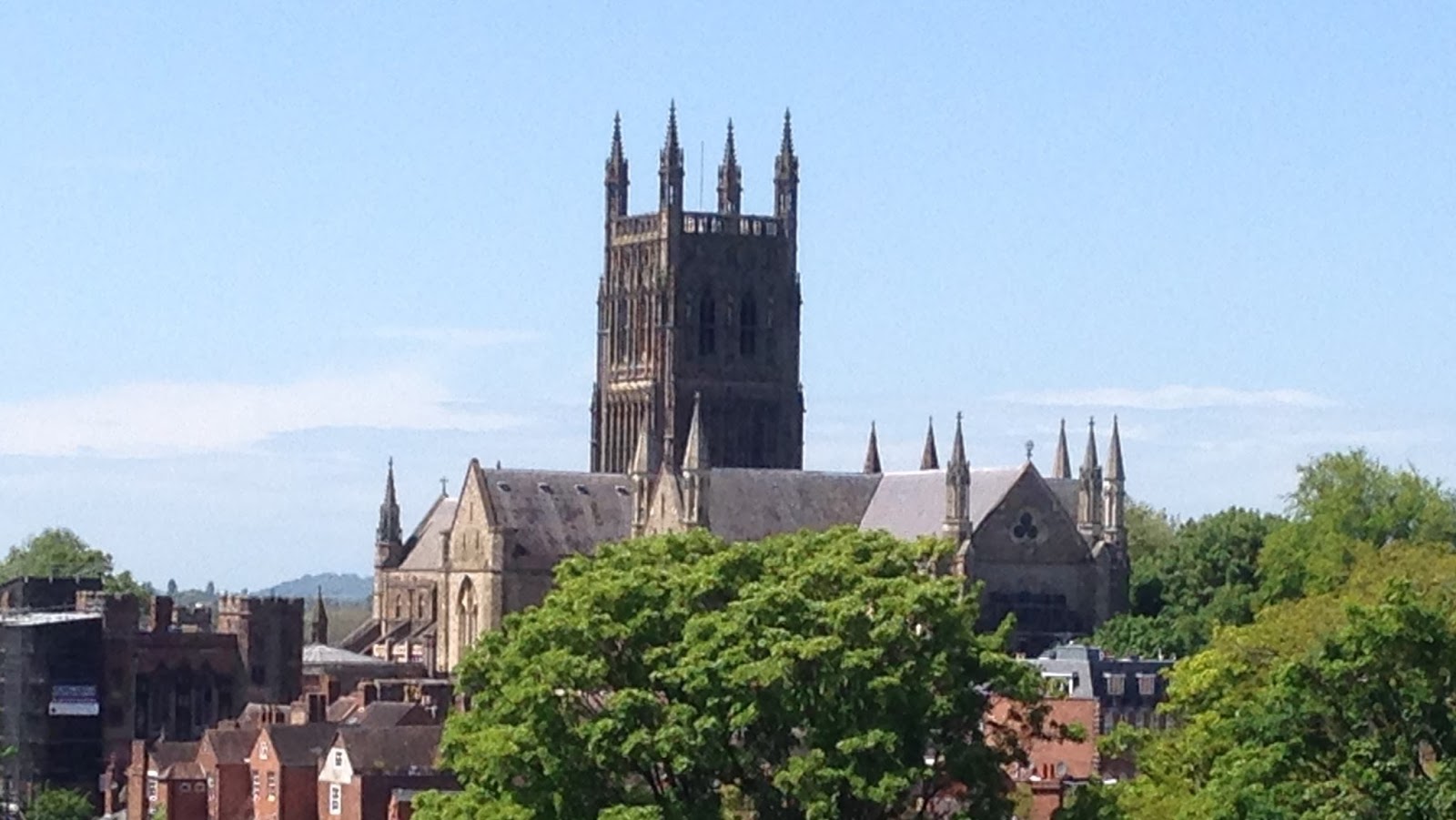
M.J. Logue’s Uncivil War series begins in the fair city of Worcester (RED HORSE), a city which saw its fair share of strife during the Civil War period, ending with the Battle of Worcester on 3 September 1651, a battle that is the starting point for my own GUARDIANS OF THE CROWN series. My latest release,  EXILE’S RETURN, marks the end of the series which spans the years of the Interregnum from 1650 to the restoration of King Charles II in 1660.

Last year I was fortunate to go back to Worcester. I say ‘back’ because, although I’m an Australian, my family has had a long, long association with Worcester, most notably boasting a High Sheriff of Worcester (my great grandfather) and a well-respected MP and County Councillor (my grandfather) and my father served under the colours of the now defunct Worcestershire Regiment.

My last visit to Worcester had been some twenty plus years ago when I was researching a little story I was writing centred on the Battle of Worcester. I wanted to write about a group of friends/comrades and what this seminal battle of the English Civil War meant to them and their families. This led to the Guardians of the Crown series.  The stories follow the lives of three young men, Jonathan Thornton (.  (BY THE SWORD), Kit Lovell (THE KING’S MAN) and Kit’s brother, Daniel (EXILE’S RETURN). To M.J. Logue’s disgust they are, I am afraid, ‘rascally royalists’. However she will understand what it is to have imaginary friends… and how very real the characters in our stories can be so it will come as no surprise to say I arranged an assignation with my characters during my visit!

We moored our canal boat below the Sidbury Lock within spitting distance of The Commandery and the site of what was once the Sidbury Gate through the walls of the old city (now long since gone). Having an afternoon free, I abandoned my travelling companions and stepped down on to the tow path of the canal (which had not been there in 1651). They were waiting for me - Jonathan Thornton, Kit Lovell and his brother Daniel, my companions from the past and they would be my guides for the afternoon.

We began with The Commandery (that was its name long before the events of 1651). In its past it had been a merchant's house, a hospital and in 1651 became the Headquarters for Charles II.
(Jonathan) attended the meetings at the Commandery and concluded the house had been wrongly named. He saw precious little evidence of command taking place within its walls...In the endless councils that took place in the hall the young King found himself assailed from all sides by conflicting advice.  .  (BY THE SWORD)

From The Commandery we set off up the hill to Fort Royal where a royalist battery had been established to defend the approach to Worcester along the Sidbury road. I won't go into the details of the battle itself (I've written about it elsewhere...click HERE). Suffice to say that while the royalists held Fort Royal, Cromwell had taken Red Hill and Perry Hill. The king himself led an attack on Red Hill but was driven back to the city. Fort Royal fell, the royalist defenders slaughtered to a man and the guns turned on the city itself.

American readers may be interested to know that it was on this hill that an oak tree was planted in commemoration of a visit by Thomas Jefferson who is quoted as reminding all Englishmen that it was at Worcester that the concept of Liberty was fought for... you can read his quote on the plaque below...

My companions led me back down the hill toward Sidbury Gate...
The Parliament guns had been brought to bear on the gate, turning the retreat into wholesale slaughter. Amidst the screaming of man and beast, the carnage of blood and guts and with shot pounding into the walls and the city, the King managed to get back through the gate. Jonathan followed through the confusion, scrambling over an overturned oxen cart to reach his King. .  (BY THE SWORD)

No trace of the gate or walls remain today (destroyed for the building of the canal in the 1760s), just one small plaque on a wall marks its existence. We turned into the city and down one of the last remaining authentic city streets - Friar Street (curse those 70s redevelopments!). Still lined with half timbered houses, it is only here one can still get a feeling for 17th century Worcester.
Wilmot pulled at Jonathan’s arm and they both ran up Friar Street, toward the King’s lodging. Jonathan took only one look back to see Giles, fighting like a virago, a small defence against the mass of red-coated soldiers who now flooded into the city from all gates except one: St Martin’s Gate stood close by the King’s lodging and remained as yet unbreached. .  (BY THE SWORD)

It was here in Friar Street that Jonathan, Giles, Kit and Daniel lodged in a house that may have looked a little like Greyfriars (now a National Trust property). Here they played cards on the night before the battle.
Another evening at the Commandery had ended in bickering and Jonathan trudged wearily back up Friar Street to his billet ... In the downstairs parlour of the large, half-timbered house, Giles played cards with Kit Lovell, who had recently rejoined them. They were both fiendish card players, with a tendency to cheat, and Jonathan declined their invitation to join them. .  (BY THE SWORD)

Further up Friar Street we came to the building now known as The Charles II house (and rather ignomiously - a pie shop) which had been the King's Lodgings and from which he escaped.
They found the King within his lodgings, watching uncomprehendingly as Buckingham burned papers on a hastily lit fire.
‘We must go, Your Majesty,’ Wilmot said.
The King looked up at his old friend and advisor. ‘Leslie will come,’ he insisted. ‘We will rally again.’
‘No, Your Majesty,’ Buckingham spoke. ‘It’s too late. Leslie has failed us, Hamilton is fallen. We must away while we still have breath in our bodies.’
The noise of the fighting, drawing closer up the street, brought the King to his feet. With the Parliament’s soldiers at the front door of the house, the King and his party left by the back. Taking the nearest horses they fled, at a hard gallop, through St Martin’s Gate, the gate that led th(e way to the north. .  (BY THE SWORD)


Finally at the great Worcester Cathedral, we took a moment to visit the tomb of bad King John (according to M.J. Logue in RED HORSE, defaced by a large, bad tempered black horse in 1642 when it was used to stable Parliamentary cavalry). The prisoners from the battle had been held in the Cathedral following the battle.

At the end of that bloody day, the King had become a fugitive in his own land and Daniel, nursing a wound to his right arm, had huddled against the tomb of King John in the great Cathedral of Worcester, a prisoner like the hundreds of others who had survived the battle. With the cold stone pressed against his face, he had hoped that no one would notice the shaming tears of humiliation. (EXILE’S RETURN)

Here we parted company, my imaginary friends returning to the past, and I trudged back through the streets of Worcester to meet my real friends at the Worcester Porcelain museum (in what had been a thriving factory on my last visit!).

About EXILE’S RETURN
The breath-taking conclusion to Alison Stuart’s English Civil War trilogy introduces a heroine with nothing left to lose and a hero with everything to gain…

England, 1659: Following the death of Cromwell, a new king is poised to ascend the throne of England. One by one, those once loyal to the crown begin to return ...
Imprisoned, exiled and tortured, fugitive Daniel Lovell returns to England, determined to kill the man who murdered his father. But his plans for revenge must wait, as the King has one last mission for him.
Agnes Fletcher's lover is dead, and when his two orphaned children are torn from her care by their scheming guardian, she finds herself alone and devastated by the loss. Unwilling to give up, Agnes desperately seeks anyone willing to accompany her on a perilous journey to save the children and return them to her care. She didn't plan on meeting the infamous Daniel Lovell. She didn't plan on falling in love.
Thrown together with separate quests – and competing obligations – Daniel and Agnes make their way from London to the English countryside, danger at every turn. When they are finally given the opportunity to seize everything they ever hoped for, will they find the peace they crave, or will their fledgling love be a final casualty of war?

If you would like to hear an excerpt from EXILE’S RETURN professionally read. Click HERE

EXILE’S RETURN is available on AMAZON, KOBO, Ibooks and all reputable ebook stores

ABOUT ALISON

Award winning Australian author, Alison Stuart learned her passion from history from her father. She has been writing stories since her teenage years but it was not until 2007 that her first full length novel was published. A past president of the Romance Writers of Australia, Alison has now published seven full length historical romances and a collection of her short stories.  Many of her stories have been shortlisted for international awards and BY THE SWORD won the 2008 EPIC Award for Best Historical Romance. 


Her inclination for writing about soldier heroes may come from her varied career as a lawyer in the military and fire services. These days when she is not writing she is travelling and routinely drags her long suffering husband around battlefields and castles.


Readers can connect with Alison at her website, Facebook, Twitter and Goodreads.


And don’t forget to enter my Guardians of the Crown contest (Closes 15 March):  click HERE

Friday, 26 February 2016

William Dobson: the Cavalier Chronicler


Tide, time and weather have not yet permitted me to go over to St Michael’s Mount to look at the mysterious miniature, so I have been a little remiss in this latest blog post. 

But in the meantime – this Dobson chap. 

William Dobson was described by the diarist John Aubrey as “the most excellent painter that England hath yet bred”. 
He was born in 1611, the son of another decorative artist called William Dobson, and died in poverty after what is tactfully described as “an irregular life” at the age of 35, buried on 28thOctober 1646 in St Martin in the Fields. He married twice: once to Elizabeth, who was buried at St Martin-in-the-Fields on  26thSeptember 1634 (bearing in mind that at the time of her death Dobson would have been twenty-three years old. That’s no age to be a widower -) and then to Judith Sander, of whom he painted a rather lovely portrait, in December 1637. She survived him, to re-marry: there is a record in the church of St Bartholomew the Great, London, of a little girl, Katherine, daughter of a William and Judith Dobson, christened 16 April 1639. 

Apprenticed to the younger William Peake, and thought to have then joined the studio of the German-born painter and tapestry designer Francis Cleyn, it’s interesting that unlike his mentors Dobson seems to have been exclusively working in paint. 
Cleyn was described in his heyday as “a second Titian” and as “il famossisimo pittore, miracolo del secole” – most of his employment was in decorating the mansions of the gentry, including Somerset House, Carew House, and the Gilt Room at Holland House in London. With the civil war his patrons were forced to cut back in their spending, though, and most of Cleyn’s prosperity came from engraved book illustrations and etchings 
William Peake was credited with making a gilded staff for the effigy of the young Prince of Wales in 1612, and although no copies of his paintings still exist, there are various engravings either by him or published by him in the National Portrait Gallery – mostly of eminent courtiers like Lord Darnley and the Earl of Worcester. 

Master Dobson, though, painted: and so far as we know, nothing else. There are no surviving engravings, sketches, sculptures – nothing but a substantial body of some sixty pieces of art, which, given that Dobson died at the age of thirty-five, and assuming that the majority of his work displays an adult maturity, must have represented aphenomenaloutput. We know nothing of any apprentices, and his death in reduced circumstances would suggest that he had not been in a position to train a younger artist for some time previous to this: I am surmising, therefore, that all his work was done by himself, not – as was often the case with many of the fashionable artists of the Stuart era – merely the face and hands, and the background filled in by a journeyman. 

During the 1630s he made a modest living – presumably as a portrait painter – and but when Charles I’s court painter Anthony van Dyck died in 1641, Dobson became serjeant painter to the King and groom of the privy chamber. (There is a story that Van Dyck himself introduced Dobson to the King when he saw one of the young artist’s paintings in a shop window.) 
When civil war broke out, he followed the King to Oxford 

He was, in effect, the King’s chronicler, and so it was no surprise that towards the latter end of the war when the Royalist star was waning, that poor Dobson’s popularity - and commissions -declined with it. 

Now I have to say, from a personal point of view, I love his paintings: they’re not formal, posed artworks, but real flesh and blood people – not all of whom I would like to be in a small space with, to be fair: Endymion Porter looks like a beery old toper and there is a twinkle in his pouchy eye best described as lewd.Carry On Cavalier, in his full glory. 
copyright Yale Center for British Art, Paul Mellon Collection

My own personal favourite is the portrait of a family, probably that of Richard Streatfeild, c. 1645. 
Mum looks as if she wants to laugh, and is stroking the curls of a very impish young miss in a pink frock, who appears to be playing peep-bo with the artist. 
Dad is looking sternly into the middle distance, whilst being poked in the belly by his youngest with a handful of coral. 
It is a very real, and very tender, family portrait, with real – and not very beautiful – people in it. 
(If it is the Streatfeild family, and if you’re curious, the children would be Alice, who would have been about 18 months old, William, who would have been a few months old, and six-year-old Henry. William and Henry lived into the first quarter of the 18thcentury, and Alice went on to marry William Woodgate, the Sherriff of Kent, in 1664. Richard and Anne Streatfeild had another three children after these three, and amazingly, every single one survived to adulthood. Don’t you love happy endings?) 

So. William Dobson. Fantastic painter, not as well known as he should be, a short but tragic life. 
Dead at 35, dying in debt in 1646 back in London. 

How did he manage to paint a miniature of King Charles for Sir Bevil Grenville, when he wasn’t a miniature painter –so far as we know?

The mysterious miniature of St Michael's Mount plays a part in my new book The Serpent's Root, available for pre-order at mybook.to/TheSerpentsRoot

Wednesday, 10 February 2016

The Mystery of the Miniature on the Mount - St Michael's Mount and the Grenville Miniature

And it's not one that I have an answer to, I fear.... yet.

Sunday, 10 January 2016

The Serpent's Root - Cornwall 1646.Two months and counting....

Release date of March 21st and if you're wondering what may have befallen Hollie Babbitt and the rebel rabble since the end of "A Wilderness of Sin" - here's a taster...

“I want to go home,” Luce said dully, and turned his head on the pillow, though his eyes stayed closed. “I want to go home, Hollie.”

“Aye, I thought –“

He was mending, and his hair was lank, sticking to his forehead with sticky sweat: bless the lad, there wouldn't be a girl in Hampshire who'd look at him twice, now, but he opened his eyes then and looked up at Hollie.

"It's all right," he said, in that rusty, thready voice, strained with coughing. Closed his eyes again. "I'm sorry. I - she - I dreamed of her. Of Gray. It was nothing. The fever. I -" He trailed off, and under the blankets, his chest jerked, as if he might have sobbed. Only the once. "I almost believed it was real. That it - that she - that this was the dream, and she the reality. That I might wake and find myself at Bristol again, and be -. It was the fever. Nothing more."

"Just the fever. Aye. I know." And he wanted to do something reassuring, just a reaching out so that Luce might know that his lost girl might have faded like smoke, but that his friends were here, and real, and solid. But what comfort was that, when you had dreamed of a loss made whole again, and woke to find yourself in a lonely bed? Hollie put his hand on Luce's shoulder, and squeezed, gently. (The brat was a boy again, all skin and bone and tousled hair. That made Hollie's heart hurt, too, for the lad had no right to be so fragile.)

"Just the fever," Luce echoed. "Surely." And then he closed his eyes, and one single tear made its way from under his lashes, and slid down his face into his tangled hair. "It was a good dream, though. I wish -"
"No you don't," Hollie said, for that way lay madness.
“I miss her,” he said, as if Hollie had not spoken, and his voice was as flat as ever, as if he were talking of a skipped meal, or a forgotten engagement. “All the time, I miss her. And I do not know how I might bear it.”

And how could he answer that, without sounding as if Gray were a thing of no account? You get used to it? There will be other girls? “Yes,” he said, eventually, and hoped that was sufficient.

“She was not beautiful. I never counted her beautiful. But she was- alive, she was always so, so – she was never still, was she?” For the first time in weeks, another slow tear made its way from under his lashes, trickling down into his hair, soaking the greasy pillow. “Hollie?”

“Aye?”

Luce covered his eyes with the back of his wrist. “How do you forget?” he said, in a tiny voice.

And all Hollie could say was, “You don’t, Luce. You keep putting one foot in front of t’other. You don’t forget. But you get used to it.”
No consolation to think that after almost ten years there were still nights when he dreamed of Margriete, and still hurt to wake and find her gone. And that just for that first heartbeat, it hurt as much as it had.
“It will always hurt?” Luce said, and Hollie nodded, forgetting the lad had his eyes screwed tight shut.

“Like any other scar, brat. It will always hurt, if you get touched on it.”

“Good,” he said fiercely.  “For – I c-cannot bear that she should not be here, Hollie, and yet I cannot bear to pretend she never was.” And he sat up, quite forgetting that he was supposed to be on death’s doorstep, with all his tangled dirty hair falling about his face, and he buried his face in his two hands and sobbed like a little boy, with no thought for his beauty or his dignity. “It hurts,” he wailed, “it hurts, Hollie, it hurts!”

Aye. Well. Luce had forgot his beauty and his dignity, but Hollie was reminded, suddenly, that he had a daughter. And that one day, as the sparks flew upwards, she would look to him to comfort her. It was thinking of Thomazine that he sat on the edge of the bed and put his arms round the brat, patting him gingerly on the shoulder as he wept.
“It’ll all come good, Luce,” he said, and closed his eyes and thought of Thomazine. “It’ll all come good.”

Tuesday, 29 December 2015

The Tudors are SO 2015. This? Is Where It's All Happening


But the Tudor era is a period of lust, of intrigue and sexy debauchery and passion and jealousy and desire and excellent dresses.... so why don't I write about the Tudors?

It's a funny one. I mean, it'd be easier if I did. I'd be riding on the coat tails of Philippa Gregory and Anya Seton and Hilary Mantel - and everybody knows about Henry VIII and his convoluted love-life, and Elizabeth (and Essex....maybe) and her even more convoluted and intriguing passions. The fashions are gorgeous, the TV producers and the film producers are crying out for bodices to rip open and breeches to undo: why, in the name of creation, am I writing about a period mostly known for its unflattering fashions and spawning the man who coined the term "warts and all"?

And I guess the answer is - because I find principle sexier than unprinciple.

I'm fascinated, intrigued, and ultimately repelled by the English Civil Wars - a war without an enemy, as the Parliamentarian commander William Waller wrote in 1643 to his friend the Royalist commander Ralph Hopton. "We are both upon the stage and must act such parts as are assigned us in this tragedy, let us do it in a way of honour and without personal animosities".
I think it's interesting that many people's perception of the protagonists now is that the King's supporters were fun-loving, free-spirited party animals who loved wine, women and song - 17th century rock stars, in effect - whilst Parliament's were dour, short-haired, joyless and worthy.
It's cobblers, of course - both sides had men of fire and honour, as committed to their cause as each other.
And to me, that's considerably more appealing than a fat old guy with a bad temper and a gammy leg, a sexual predator who abused his power to bribe, flatter and coerce women into his bed and whose politics were - allegedly - based in his codpiece.

I think we love the idea of the Tudors because they're so marvellously larger than life, an almost Machiavellian world of political treachery and intrigue apparently centred on a thing we all understand - sex. We "get" desire, and jealousy, and love-conquers-all; we understand, we sympathise with, a world where a man-monster is a figure of terror as well as desire - almost the ultimate Christian Grey, the sexy uber-CEO who manipulates as well as seduces.
And maybe the idea of a quieter passion isn't so flamboyant. The Wars of the Three Kingdoms don't inflame the public imagination the same way because there is, simply, no sex involved. Oliver Cromwell looked like a potato. (Elizabeth must have seen something worth the having in him, because they had a long and happy marriage and a number of children.) Thomas Fairfax was married to the somewhat volatile Anne for twenty-seven years, and praised her lack of beauty as a virtue in his - somewhat dodgy - poetry. Charles and Henrietta Maria were uxorious enough that she went over to Europe, sold her jewellery, and raised troops for him. Rupert - well, Rupert never married, so let's not mention Rupert's love life. (Suffice it to say it was varied and active.)

It's not that women were not strong, involved, characters in their own right. Why should Brilliana Harley, sending the family plate to safety in boxes marked up as "Cake" to avoid detection by Royalist troops, be any less appealing that poor hapless Anne Boleyn?
Or if your taste runs towards tragic romantic heroines, Bridget Cromwell, travelling across a war-torn country to marry her scarred hero Henry Ireton under siege in Oxford, only to be widowed so short a time later?
Or the King's spymistress, Jane Horwood, intelligencing for him and loving him at one and the same time? (Oh, I hope she had some happiness with him, even if his letters to her portray their liaison as more pragmatic than romantic. Her husband was such a vile, abusive, violent piece of work, I do hope that Jane found love, after a fashion, with Charles - someone who was decent, and honourable, and treated her with courtesy. Not my type, but then what do I know? I'm a Fairfax girl...)

So many stories, and so much passion - but for the spirit, not for the body. For a cause, for a thing which people - both Royalist and Parliamentarian - believed in with, literally, the last drop of their heart's blood.

And as for the fashions? Quite like the Elizabeth of Bohemia look, myself.

Sunday, 22 November 2015

All For One, or Four For the Price of Three...


True fact. All four of the Uncivil Wars books are now available in rather elegant paperback, and from now until Christmas there's 25% off each of them. 

Which means you can buy all four, and only pay for three! 

Red Horse (An Uncivil War 1 - discount code at checkout is YMNTQP4M
Command the Raven (An Uncivil War 2) - discount code at checkout is 7EACLL7F
A Wilderness of Sin (An Uncivil War 3) - discount code at checkout is KJXPTBD7
The Smoke of Her Burning (An Uncivil War 4) - discount code at checkout is 6JQNFC4E

Get them quick....before Cromwell cancels Christmas! 

Tuesday, 3 November 2015

In the Shadow Of The Storm by Anna Belfrage - a review

In The Shadow of The Storm: Book 1 of The King's Greatest Enemy

I have to admit to a degree of worry as I started to read this new book, because I am a great fan of Ms Belfrage's Graham Saga.

My first worry was that it wasn't going to be as good - and my second was that it was going to be Alex and Matthew in the 14th century: a trap that many successful authors fall into, of replicating carbon copies of their successful characters in another period of history.
Well, I needn't have worried on either head.

I am very fond of Alex and Matthew Graham, but there is always - in my reading - that element of tension in their relationship. With Adam and Kit, despite the somewhat - unusual - beginning of their marriage, there is never any doubt for me that no matter how tumultous this period of history is, their love is solid. This is not, I don't think, a will-they won't-they story, set against a faintly-drawn generic historical background. It's a story of will Fate let them, in what has to be one of the most violent, tumultous, passionate, uninhibited periods of English history. A man and a woman, who find each other, and are determined that conflicting loyalty, intrigue, and murder will not come between them.

Be not misled, gentle reader. We are not in the realms of courtly love here. We are dealing with a real and passionate period, where a brutal punishment can be meted out to a man in scenes of graphic savagery, and a woman be poisoned to death by her own family - and where the same man who raises a sword with violent skill, can make love to his wife with kindness and tenderness.
We are also dealing with a very accomplished author, who can describe love as well as pain with skill and empathy.

I thoroughly enjoyed this book. Alex and Matthew are very much a self-contained unit, but Kit de Courcy and Adam de Guirande are a fantastically-drawn pair of lovers enmeshed in a complicated political and social web. And a well-researched, authentic, believable one, that feels as right to the reader as a warm wool surcote.

Be warned: there is a considerable amount of brutality in this book. The Welsh Marches in 1321 were a place of unpredictable political allegiances, where a wise man keeps an eye on the main chance. Not a period where an author should tread, without a considerable amount of background research, and certainly not a period where an author who fears to describe spilled blood should go. (Just as well this author fears neither.)

I scent a long and happy relationship for this reader, with the de Guirandes....

Sunday, 4 October 2015

Meet the Staith - Abbots Staith exposed


 The Abbot's Staith in Selby is, in the new book, the site of Sir John Belasyse's powder store in the city, and the scene of one or two of the climactic moments of the book. 
I don't think it was ever used as a powder magazine, but even so, I've taken some artistic licence with this fascinating building. In recompense, the first month's royalties of the book will be going to the Staith for the restoration fund of the building - so buy The Smoke of Her Burning and support the Staith!


The warehouse building currently known as the Abbots Staith, near the river Ouse in Selby, has been interpreted as being from the 14th century in a survey done in 1995, based on the style of the stonework. The building is shaped as a shallow capital 'H' with narrow slot windows to the ground floor frontage and leaded lights to the second floor which would have had internal shutters. At 132 feet 3 inches long by 60 feet 7 inches wide it is slightly shorter but wider than the nave of Selby Abbey (140 feet by 58 feet). All the doors face the river, except for one in the front central bay which has a flat or 'French' arch and would have been the main access route from the river to the monastic complex.


The name Staith or Staithe refers to a jetty or wharf and there are two ancient monuments on the site, the warehouse building and the wharf area. Most of the latter is now covered by a 20th century jetty, but the piles and timbers can be seen underneath this at low tide. The building itself is listed Grade II* and the English Heritage Buildings At Risk registers calls it a former monastic wool warehouse, reflecting the main trade of the medieval abbey in the town.

Formed in 2014 the Abbots Staith Heritage Trust are a group of volunteers dedicated to preserving, restoring and bringing the building back into use for the community of Selby. Some of the volunteers have spent many hours researching the Staith and have found references to in old texts dating back to the 15th and 16th century, including one that calls it the ‘Great Staithe’.

In more modern times a two storey Georgian building was added to the front west wing of the Staith warehouse. This was known as the Counting House, as it was where taxes and tithes were paid. The land and building were owned for a time in the 18th and 19th centuries by both Lord Petre, lord of the manor of Selby and by the renowned surgeon and naturalist Jonathan Hutchinson, who was born in a cottage immediately behind the warehouse in July 1828, which is now the office for Westmill Foods. There is a blue plaque on the wall celebrating this fact.

For much of the 19th century and into the early 20th the warehouse was part of the Abbot’s Staith Flour Mills, that business passing through various owners, before the building was sold in 1911 to George Woodhead and Sons, Seed Merchants.

During the years from 1911 to 1995 the Counting House became the shop front and small offices for Woodhead Seeds (later larger office space was created on the top floor of the west wing of the warehouse itself). Woodhead Seeds moved out in Spring 1995 and since then (aside from a brief use as a car radio outlet in the shop front) the main building has remained empty, though it is still owned by a member of the Woodhead family.

On April 20th 2015 Abbots Staith Heritage Trust took a one year licence on the Counting House as a base to promote their vision for the restoration of the building. More information can be found on their Facebook and Twitter accounts, with a full website coming soon.


Friday, 4 September 2015

Rosie and Tyburn. Luce and Rosa. Meet Russell's Doubting Thomas....


“Got a surprise for you, Hapless,” Hollie said smugly.
Percey had groomed the bay horse till its coat gleamed like a dark conker. He'd even acquired some chalk from God knows where and he'd whitened the gelding's stockings. There were times when you had to wonder about Mattie Percey's previous career in a stable-yard in Essex. Just how honestly he might have come by certain skills. That lad was a better painter than Lely.
What he hadn’t done was improved the big horse's temper, and it came out of the line rearing, ears pinned against its skull. Mattie had his hand gripping the bit-ring, trying to keep the horse's head down, and even so the bay nearly had him off his feet.
It was a bloody fine horse, though. Big-built, not one of your lightweight sprinters like Luce Pettitt's spindly witless Rosa: backside like a gable end and a proud arch to its thickly-muscled neck that hinted that someone might have been a little behindhand with the shears to its gelding. That was a beast that'd go all day chasing Malignants and come in at the end of it dancing. It was the sort of mount any junior cavalry officer with any dreams of a future career in the Army might covet, provided a man could train some sense into its thick head. Plenty of staying-power, plenty of fire and dash, though possibly a bit light on good humour. Hollie closed one eye and looked at the bay horse consideringly where it ramped and curvetted like some maniac heraldic emblem.
"What d'you reckon to him, then?" he said, and looked at the scarred lieutenant, expecting to see gratitude and pleasure on that cold, half-lovely face.
Instead the lad was white to the lips, the great scar on his cheek standing out a most unlovely purple, and his eyes were as mad as the bay horse's.
"Is - thish - intended to be meant in humour?" he said stiffly, and his voice had that funny slur it had when the ragged muscle in his cheek had gone stiff as wood, like it did when he was tired or ungovernable. Or drunk. That was still always a clear and present possibility.
Hollie shook his head, thinking he must have misheard, or Russell must have misheard, because –
"All right, ain't he?" Percey said happily, still being jerked around like a rag doll by the beast's flinging head, but as cheerfully good-humoured as ever he was even when his arm was being yanked from its socket by an unwanted cavalry remount. "Want to take him out, Hap- uh, Lieutenant Russell? Take a bit of the ginger out of his heels?"
"I. Should. Rather. Be. Dead," Russell said, through gritted teeth. Flung his own head up, looking not unlike the bay horse, and glared fiercely at Hollie, and Hollie would have sworn to it the lieutenant's dark eyes were brimming with wholly incomprehensible tears. "A righteous man regardeth the life of his beast: but the tender mercies of the wicked are cruel."
"What?" Hollie said blankly, and Russell snarled at him, actually snarled, baring his teeth like a dog.
"The Book of Proverb. Ss." He bit off the last consonant with a hissing, furious sibilance, and then hit himself in the temple with the heel of his hand. "Shir."
And then wheeled about and was gone, shoving Luce rudely out of the way, storming back to the house. "What," Hollie said again, shook himself, "what the bloody hell was that all about?"
"What on earth did you say to him - oh, sir, that was not well done!"
There were times when Luce didn’t half remind Hollie of Het. Well, Hollie's wife was his cornet's father's little sister, it wasn't so much of a surprise, but even so. That hurt, shocked, disappointed look was pure Het, an expression she reserved for when he did something completely stupid. What, precisely, he'd done this time, he did not quite know, save that he was still trying to make things all right for a lad who was as tricksy to handle as a barrel of rotten gunpowder, and he didn’t know from day's end to day's end what mood he was going to be on the receiving end of. Like walking on eggshells, if eggshells were volatile, suspicious, and prone to soothing their tempers by getting fiercely rat-arsed.
"What wasn't?" he said warily. "What, seriously, sir? You did not mean to be - um - funny?"
"No, of course I bloody didn't!"
Luce gave a great sigh. "Ah, God. So you - you know - did you look at the beast? Other than, um, you know - professionally?"
"What -" With one final jerk of the bit, Mattie had the bay horse with all four feet on the ground. It was still a handsome beast. It was just - odd-looking. Three white feet, and a great lopsided white blaze to its face. One blue eye, and one, slightly manic, brown one.
A perfectly sound, sturdy, fine cavalry mount, who just happened to look both ugly and irregular. It was a bloody good horse, sound in wind and limb, beautifully put together, a mount a man could rely on - could be proud of. But now Luce came to mention it, the brute did look a bit like it had been sewn together from bits of at least two other horses. Good ones, but -.
And that had been a coincidence.
"Ah," said Hollie.


The Smoke of Her Burning. October 2015.

Saturday, 1 August 2015

The Smoke of Her Burning - and a bargain!


To celebrate Yorkshire Day, an exclusive cover reveal of the new book, The Smoke of Her Burning, set in Selby 1644. And to celebrate the cover reveal, the first three books in the series will remain at 99p each till the end of August! - help yourself here.


I hope there's a good explanation for this, Colonel Babbitt," Fairfax said, with a sigh. 
"No," said Hollie honestly, "but there is an explanation." 

There's a lot of miles between Essex and Cheshire.... 

...and newly-promoted Colonel Hollie Babbitt is cursing the most recent additions to his company, for every step of them. 

A scarred lieutenant with a death wish, and they don't call him Hapless for nothing. 
Captain Drew Venning. And his dog. 
Captain Penitence Chedglow, last seen smashing up the inside of Worcester Cathedral in an excess of godly zeal, and his new companion in bigotry, the silent but violent Webb. 
The mysterious Trooper Gray, a one-man insurrection. 

Forced to leave a posting to Cromwell's Eastern Association as a result of some more than usually scatter-brained chivalric meddling by the posh poet Lucey Pettitt, Hollie finds himself up to the elbows in freezing mud at Nantwich, mired in intrigue and insubordination. 

When Hollie's old nemesis Prince Rupert relieves the siege at Newark, freeing up a cavalry force to hammer Fairfax’s garrisons in Yorkshire, it looks as if the gallant Parliamentarian defenders will be overwhelmed in the North. But after a fierce attack is repulsed, the Northern Royalists retreat to their foothold at Selby, with its vital strategic command of both the Ouse and the road to York. 

It will be hard. It will surely be bloody. But Hollie’s rebel rabble may be the difference between victory and defeat for Parliament in the North.

Sunday, 26 July 2015

If you like it, put a vote on it - A Broom At The Masthead preview....


He sniffed surreptitiously at the lustrous collar of his court suit.

It smelt, faintly, of stale rosewater and tobacco and sea-coal fumes, with an acrid note of sweat, and a slight overlay of wine. Under that was the strange, fugitive scent of silk, of tar and the sea and the spices of the hold of an East Indiaman - although that was possibly in his imagination, for he had never set foot on a ship bound for anywhere more exotic than the Low Countries.

He'd been told, in no uncertain terms, that he'd shirked long enough. That an officer of some seniority, even a supply officer of no great military significance or birth - General Monck had been very specific on that last, and Russell could still hear his commander's round rural Devonshire accent in the memory of it - it was his duty to present himself at court, and pay his loyal respects to His Majesty, on the glorious event of his restoration to the throne after eleven years of misery under the Commonwealth.
And then Monck had glowered, and narrowed his little bull's eyes, pouched in sagging red flesh. "You'll do the pretty, Major Russell, for all ye were a damnable Roundhead."

The which Major Thankful Russell could not argue, for with a name like Thankful, he could scarcely deny his staunch Puritan upbringing, and having almost had himself executed as a political subversive, he had to admire General Monck's perspicacity.
But. He had thought that after twenty years of keeping his head down, of being a ferociously good supply officer of no great military significance or birth, of waking and sleeping lists and requisitions and logistics - after a life of ruthless and selfless service, he might not, actually, be forced to show his face at court against his will. Monck said it was a matter of respect. Russell was a god-damned administrator, a jumped-up pen-pusher, who the hell did he think he was, in his arrogance, to refuse to present his respects to His Majesty in person?

They forgot, you see. They saw this neat, slightly austere, mouse-haired gentleman in his forty-second year, tall and a little stiff in the shoulders as a result of stooping over his requisition lists these last years. Short-haired, where preposterously curled wigs were the fashion, and so they called him Old Crophead, for his old Parliament leanings and his present lack of vanity. Not given to excess, of any nature, but a most prim and sober and respectable senior officer, the sight of whose scarred face could be relied upon to damp the high spirits of any gathering.
They forgot that twenty years ago he had been a firebrand, and a rebel. He looked cold and implacable, but how else might a man look, who had taken the thrust of the shattered butt of a pike through his cheek in the early years of the civil wars?

And so it had been a matter of duty, and a direct order, that Russell should present himself at court. Well, he had. He remembered little of it. He had, admittedly, fortified himself with perhaps more wine than he ought to have: anything to stop the shaking of his hands, his absolute bone-deep horror of being so conspicuously displayed in a public place. More than that, though, it had just been dull. Nothing happened. Lots of nothing happened. Just a lot of people talking a lot of nothing in a big room, that smelt of stale bodies and tallow and too much scent. He didn’t remember being presented to the King, though he supposed he must have, or Monck would have made him go back. Smiling politely at everyone, because he didn’t have a clue who was sleeping with whom, male or female, and it did not do to cut the reigning favourite, or the court wit. Being called Bosola, which he did not understand, but which had been kindly explained to him some months later by a friend who had read such old-fashioned tragedies that it referred to a most notorious court malcontent and bird of ill omen, in a play.

Being told, by a gaggle of cackling, bewigged striplings, that if one gilded a turd, it remained, regardless, a turd.
Suggesting to the Earl of Rochester that if he passed such remarks in Russell's hearing again, Russell would take Rochester's ungodly ape and insert it where the Lord's grace did not shine.
(Russell had known poets, in his time. The men he knew would have hesitated to scrawl such doggerel as Rochester wrote, on the wall of a troop latrine. He was not impressed by a seventeen-year-old libertine. And he meant it about the monkey.)

He'd stayed close to the wall, mostly, trembling, with the small of his back against the moulded plaster, taking some comfort from that cool strength. Holding to his duty, because that was what he did, what he had done since he was seventeen, and first a young officer. Feeling like an impostor, in his charcoal-grey lutestring silk, with a jacket that was so short and tight it barely covered his arse, and great billowing shirt-sleeves hanging from under the shrunken sleeves. Festooned with ribbon, like a damnable maypole, with a cravat that trailed in his supper if he was not cautious how he sat. Ribbons and lace and high-heeled shoes, which made him mince like a girl, and he could not and would not grow one of those ashy smears of moustache, even if his scarred face would allow it.

He had been a little drunk, and a lot nervous, and his teeth had been chattering on the rim of his delicate Venetian glass goblet even before he'd seen a face he knew, however vaguely: the chubby, deceptively amiable countenance of Charles Fairmantle, a distant Buckinghamshire neighbour. Member of Parliament now, he thought. Couldn't remember, and did not care, overly much. Fairmantle was a toady and a lecher, and a hanger-on to the peripheries of Rochester's lewd cohort, and the touch of his pudgy hand made a sweat of sheer repulsion break out on Russell's top lip, as if a warm slug had crawled over his skin.

They exchanged idle pleasantries, or at the least, Fairmantle made idle pleasantry and Russell stared blankly at him for the most part. And then,
"Accept my condolences, Major. A bad business. A bad business, indeed. You must be devastated."

"Oh. Indeed. Which condolences?"

The pudgy hand on his sleeve, solicitous, leaving a faint, damp print on the glimmering silk.
"I am so sorry, sir. I had assumed you knew. Your sister, major. God rest her, she - Four Ashes was burned, not three months ago, and poor Mistress Coventry with it." Fairmantle shook his head. "I am sorry. I had not meant - I had not known - sir, you turn positively pale -"

And Russell, who had hated his sister, and not set eyes on her in the better part of ten years, had bitten clean through the rim of his goblet in his shock nonetheless.

He thought that had been the moment when he had decided to come back to Buckinghamshire for good and all, though it had taken him a few months of despair and penny-pinching and soul-searching to work out how he might rebuild the house at Four Ashes.
And then a further few months of despair and soul-searching when he realised that there was only one woman he'd have entertained as mistress there, and that she was as utterly, irrevocably not for him as the moon for the moth.

Possibly he ought to have mentioned that fact to Thomazine Babbitt, for she was under no such doubts at all, as it turned out. There had only ever been one man for Thomazine, and the Lord be praised, it turned out it had always been Russell. It seemed she'd considered him her especial property since she was three years old. It might have saved him some considerable distress if she'd thought to tell him, though, he thought wryly.

Well. He smoothed the charcoal silk again, absently.

He'd thought to do her honour on their wedding day, and wear his finest.

Well, she was marrying a plain gentleman, not a courtier. He'd given all that up, along with his commission, just under a year ago. He was no man's but his own.
- And hers, of course. Always hers.

He took a deep breath, and pulled on the plain, decent, pewter-grey wool waistcoat with the plain silver buttons, and the plain, old-fashioned, straight-fitting coat that went with it.
"At least the lass will recognise you," he told himself, smiling wanly at his reflection in the mirror.
Ruffled a hand through his hair - grown to his shoulders, now, and no longer so indeterminately mouse as it had been when he'd worn it close-cropped, but streaked fair and dark as a field of wheat when the wind blows through it. She liked it so, worn long, and straight.

He was scarred, and worn, and weary, and his head hurt when the wind was in the north.
All that was true.
But Thomazine loved him. And further than that, he did not care.  


If you liked the first chapter of A Broom At the Masthead, vote for it HERE

Awarded for Excellence in Research by 17th-Century Specialists

Awarded for Excellence in Research by 17th-Century Specialists