Showing posts with label South West campaign. Show all posts

Friday, 26 February 2016

William Dobson: the Cavalier Chronicler


Tide, time and weather have not yet permitted me to go over to St Michael’s Mount to look at the mysterious miniature, so I have been a little remiss in this latest blog post. 

But in the meantime – this Dobson chap. 

William Dobson was described by the diarist John Aubrey as “the most excellent painter that England hath yet bred”. 
He was born in 1611, the son of another decorative artist called William Dobson, and died in poverty after what is tactfully described as “an irregular life” at the age of 35, buried on 28thOctober 1646 in St Martin in the Fields. He married twice: once to Elizabeth, who was buried at St Martin-in-the-Fields on  26thSeptember 1634 (bearing in mind that at the time of her death Dobson would have been twenty-three years old. That’s no age to be a widower -) and then to Judith Sander, of whom he painted a rather lovely portrait, in December 1637. She survived him, to re-marry: there is a record in the church of St Bartholomew the Great, London, of a little girl, Katherine, daughter of a William and Judith Dobson, christened 16 April 1639. 

Apprenticed to the younger William Peake, and thought to have then joined the studio of the German-born painter and tapestry designer Francis Cleyn, it’s interesting that unlike his mentors Dobson seems to have been exclusively working in paint. 
Cleyn was described in his heyday as “a second Titian” and as “il famossisimo pittore, miracolo del secole” – most of his employment was in decorating the mansions of the gentry, including Somerset House, Carew House, and the Gilt Room at Holland House in London. With the civil war his patrons were forced to cut back in their spending, though, and most of Cleyn’s prosperity came from engraved book illustrations and etchings 
William Peake was credited with making a gilded staff for the effigy of the young Prince of Wales in 1612, and although no copies of his paintings still exist, there are various engravings either by him or published by him in the National Portrait Gallery – mostly of eminent courtiers like Lord Darnley and the Earl of Worcester. 

Master Dobson, though, painted: and so far as we know, nothing else. There are no surviving engravings, sketches, sculptures – nothing but a substantial body of some sixty pieces of art, which, given that Dobson died at the age of thirty-five, and assuming that the majority of his work displays an adult maturity, must have represented aphenomenaloutput. We know nothing of any apprentices, and his death in reduced circumstances would suggest that he had not been in a position to train a younger artist for some time previous to this: I am surmising, therefore, that all his work was done by himself, not – as was often the case with many of the fashionable artists of the Stuart era – merely the face and hands, and the background filled in by a journeyman. 

During the 1630s he made a modest living – presumably as a portrait painter – and but when Charles I’s court painter Anthony van Dyck died in 1641, Dobson became serjeant painter to the King and groom of the privy chamber. (There is a story that Van Dyck himself introduced Dobson to the King when he saw one of the young artist’s paintings in a shop window.) 
When civil war broke out, he followed the King to Oxford 

He was, in effect, the King’s chronicler, and so it was no surprise that towards the latter end of the war when the Royalist star was waning, that poor Dobson’s popularity - and commissions -declined with it. 

Now I have to say, from a personal point of view, I love his paintings: they’re not formal, posed artworks, but real flesh and blood people – not all of whom I would like to be in a small space with, to be fair: Endymion Porter looks like a beery old toper and there is a twinkle in his pouchy eye best described as lewd.Carry On Cavalier, in his full glory. 
copyright Yale Center for British Art, Paul Mellon Collection

My own personal favourite is the portrait of a family, probably that of Richard Streatfeild, c. 1645. 
Mum looks as if she wants to laugh, and is stroking the curls of a very impish young miss in a pink frock, who appears to be playing peep-bo with the artist. 
Dad is looking sternly into the middle distance, whilst being poked in the belly by his youngest with a handful of coral. 
It is a very real, and very tender, family portrait, with real – and not very beautiful – people in it. 
(If it is the Streatfeild family, and if you’re curious, the children would be Alice, who would have been about 18 months old, William, who would have been a few months old, and six-year-old Henry. William and Henry lived into the first quarter of the 18thcentury, and Alice went on to marry William Woodgate, the Sherriff of Kent, in 1664. Richard and Anne Streatfeild had another three children after these three, and amazingly, every single one survived to adulthood. Don’t you love happy endings?) 

So. William Dobson. Fantastic painter, not as well known as he should be, a short but tragic life. 
Dead at 35, dying in debt in 1646 back in London. 

How did he manage to paint a miniature of King Charles for Sir Bevil Grenville, when he wasn’t a miniature painter –so far as we know?

The mysterious miniature of St Michael's Mount plays a part in my new book The Serpent's Root, available for pre-order at mybook.to/TheSerpentsRoot

Wednesday, 10 February 2016

The Mystery of the Miniature on the Mount - St Michael's Mount and the Grenville Miniature

And it's not one that I have an answer to, I fear.... yet.

Sunday, 10 January 2016

The Serpent's Root - Cornwall 1646.Two months and counting....

Release date of March 21st and if you're wondering what may have befallen Hollie Babbitt and the rebel rabble since the end of "A Wilderness of Sin" - here's a taster...

“I want to go home,” Luce said dully, and turned his head on the pillow, though his eyes stayed closed. “I want to go home, Hollie.”

“Aye, I thought –“

He was mending, and his hair was lank, sticking to his forehead with sticky sweat: bless the lad, there wouldn't be a girl in Hampshire who'd look at him twice, now, but he opened his eyes then and looked up at Hollie.

"It's all right," he said, in that rusty, thready voice, strained with coughing. Closed his eyes again. "I'm sorry. I - she - I dreamed of her. Of Gray. It was nothing. The fever. I -" He trailed off, and under the blankets, his chest jerked, as if he might have sobbed. Only the once. "I almost believed it was real. That it - that she - that this was the dream, and she the reality. That I might wake and find myself at Bristol again, and be -. It was the fever. Nothing more."

"Just the fever. Aye. I know." And he wanted to do something reassuring, just a reaching out so that Luce might know that his lost girl might have faded like smoke, but that his friends were here, and real, and solid. But what comfort was that, when you had dreamed of a loss made whole again, and woke to find yourself in a lonely bed? Hollie put his hand on Luce's shoulder, and squeezed, gently. (The brat was a boy again, all skin and bone and tousled hair. That made Hollie's heart hurt, too, for the lad had no right to be so fragile.)

"Just the fever," Luce echoed. "Surely." And then he closed his eyes, and one single tear made its way from under his lashes, and slid down his face into his tangled hair. "It was a good dream, though. I wish -"
"No you don't," Hollie said, for that way lay madness.
“I miss her,” he said, as if Hollie had not spoken, and his voice was as flat as ever, as if he were talking of a skipped meal, or a forgotten engagement. “All the time, I miss her. And I do not know how I might bear it.”

And how could he answer that, without sounding as if Gray were a thing of no account? You get used to it? There will be other girls? “Yes,” he said, eventually, and hoped that was sufficient.

“She was not beautiful. I never counted her beautiful. But she was- alive, she was always so, so – she was never still, was she?” For the first time in weeks, another slow tear made its way from under his lashes, trickling down into his hair, soaking the greasy pillow. “Hollie?”

“Aye?”

Luce covered his eyes with the back of his wrist. “How do you forget?” he said, in a tiny voice.

And all Hollie could say was, “You don’t, Luce. You keep putting one foot in front of t’other. You don’t forget. But you get used to it.”
No consolation to think that after almost ten years there were still nights when he dreamed of Margriete, and still hurt to wake and find her gone. And that just for that first heartbeat, it hurt as much as it had.
“It will always hurt?” Luce said, and Hollie nodded, forgetting the lad had his eyes screwed tight shut.

“Like any other scar, brat. It will always hurt, if you get touched on it.”

“Good,” he said fiercely.  “For – I c-cannot bear that she should not be here, Hollie, and yet I cannot bear to pretend she never was.” And he sat up, quite forgetting that he was supposed to be on death’s doorstep, with all his tangled dirty hair falling about his face, and he buried his face in his two hands and sobbed like a little boy, with no thought for his beauty or his dignity. “It hurts,” he wailed, “it hurts, Hollie, it hurts!”

Aye. Well. Luce had forgot his beauty and his dignity, but Hollie was reminded, suddenly, that he had a daughter. And that one day, as the sparks flew upwards, she would look to him to comfort her. It was thinking of Thomazine that he sat on the edge of the bed and put his arms round the brat, patting him gingerly on the shoulder as he wept.
“It’ll all come good, Luce,” he said, and closed his eyes and thought of Thomazine. “It’ll all come good.”

Sunday, 17 May 2015

A Wilderness of Sin free to download 17th May

To commemorate the execution of the three Leveller Martyrs on this day  in 1649, A Wilderness of Sin is free to download to your Kindle on this day only.

A Wilderness of Sin free download

They're Rosie Babbitt's lads. And if he doesn't speak for their fair treatment, no other bugger will....


Friday, 1 May 2015

A Wilderness of Sin - part 3, except when it's not: on writing series-es

A Wilderness of Sin

Late last year, I had a long conversation with a dear friend about this book - about promoting it, and what to do with it, and what was going on with the plot, and all that kind of doings. And my friend - let's call him Sergeant Cullis, because in my head Cullis has always been very much based on that friend - he was very keen, he gave me lots of ideas at a time when I was somewhat knee-deep in plot device. 
"Wilderness" is Cullis's book, gentle reader, and he died a month ago. He did know that at least one of the Uncivil Wars series was dedicated to him, he was very pleased because he'd never had his name on a book before. (How little it takes to make someone happy. What did that little bit of recognition cost me, and what a great deal it meant to him. There's a lesson.)

Anyway, I wanted to have it done before he died, and I didn't quite manage it.

Now I know in my head what was going on in those intervening years, between the end of "Command the Raven" at the end of 1643, and "Wilderness..." in June 1645. I know that there was a battle at Marston Moor in 1644, and that there had been some months previous of careering about the North of England not being very diplomatic with the lady of Lathom House, which turned into a rather horrible something at Bolton. I know that the New Model Army was formally created in 1645 and that things suddenly became very different for a somewhat rag-tag army who were suddenly ruled, regimented, and disciplined. And that there was a battle at Naseby after which everything changed, which was shocking and brutal even by the Articles of War of the time, and which even I, Fairfax-o-phile that I am, can't get my head round. I know the new Army was already starting to get definitely hacked off with its leaders and their broken promises, and that Rosie Babbitt, who's been on the itchy side of insurrectionist since the first, is taking his usual pragmatic stance of to hell with the politics and look after the people. None of this is in any way a spoiler.... as the fictional Cullis has said before, Rosie Babbitt could start a fight in an empty room when the mood's on him, and the factual history is documented.

But it made me think about series-es (serii?) and what they are and how they work. My first intent was to begin at the beginning and work chronologically through the wars. Start in 1642, go on to 1643.... back to 1642 to write a novella about Edgehill.... start 1644, get sidetracked, go on to June 1645 with the intention of going right through to the Royalist surrender at Cornwall in March 1646, realise that's just too much for the one book, stop at winter quarters 1645 and give everybody a chance for a breather.... go back to the Thirty Years' War for a bit of light relief...

(and then start writing a biography of Thomas Rainsborough, but that's by the by.)

I do not have a lateral mind. I'm writing "Babylon" - the North of England, 1644 book - at the moment and the history is lurking there in the background, like a dinosaur skeleton, while the story is bouncing about all over the place. Lucey's got a moral dilemma which will be long resolved by "Wilderness" but which is a very real problem to him in 1644. Russell in 1643, when he first appears, is a prissy minor officer with an attitude problem. By 1644 he's gone off the rails altogether - and, if you're wondering, I'm sure that Russell, and to a lesser degree Babbitt, would be diagnosed with PTSD if they were around today - and by 1645 he's back, hanging on to sanity by the skin of his teeth.  I've got two half-mad, damaged, shaky lapsed Puritans with mental health issues. Rosie Babbitt's holding, but fragile. Thankful Russell hasn't found anything to hold to yet. Rosie by 1645 is - to continue with the mending metaphor, his good lady being the mending-est lady in Essex - pieced together, but the glue's still wet: Russell's still in bits. To go back to an earlier time, Rosie has to be broken again, and I have to un-do all the work that went into making him as sane as he gets. And I have to remember that the Rosie Babbitt of 1645, who is quite robust, all things considered, is not the Rosie of 18 months previous: will react differently, is less inclined towards moderation, is still erratic and self-destructive and perfectly likely to go off half-cocked and take his troop with him.

Lucey took his boots off as a boy at Edgehill, and put them back on as a man. (Despite still being known as Lucey. Sorry, brat.) I've got to remember that the maturity he has by 1645 - the purpose, the sense of direction, the slight improvement in the poetry - he does not have by Marston Moor. He's still going to be a muddle-headed romantic for a good couple of years yet. I don't want Luce to be hurt, because he's such a lollopy darling, like a labrador puppy, and yet he's had such a charmed life, he is in so many ways such an innocent, despite knocking about with Rosie: you just know that at some point the wheels must come off and reality is going to come rushing in to Pettitt-land. And what that will make him, he has not yet become. He has not yet had to tie a knot on his vows, and make them new again.

And how many times can the Devil fart in Thankful Russell's face? I want to make things better for Hapless.... and yet I know I can't. It's my book, and if I wanted to wave a magic wand and make him whole and happy of course I could, but that's his journey, really. He has never been a happy boy and I can either just magic him inner peace, which would be satisfying and completely unbelievable, or he's just going to have to fight for it like every other bugger does. 

I don't want to make the series into Another Historical Fiction Series Of My Acquaintance, a series of connected standalone incidents where our hero comes through unscathed from end to end and comes out like the Perils of Pauline, smelling of roses. (I think we have established that Rosie smells of horse, sweat and black powder, so we need waste no more time on snuffing his armpits. Seriously. It makes Het very nervous.) My lads start in 1642 at a place, politically, personally, and geographically. They're not all going to make it to 1649, and those that do, will not be the same lads as they started out. They change. (Grow? Only round the middle - Captain Venning.) I don't want them to have any Damascene moments - they're real lads, they might start out with good intentions, but they cock up, they forget. Change is imposed upon them and they resist.  They set their teeth and hang on, day to day - not got time, or, by 1645, the will, for any grandiose vision. And so back and forth, back and forth, like the stars' tennis balls in Webster, struck and bandied which way please them - and they don't know where they're headed, although I do, but I can only steer, I can't compel. Not with that lot. Rebels to the core. I know that - you can see in 1645 the cracks starting to appear as this lot decide to stop toeing the party line, and to start asking pointy questions. But they might have been a bit disorganised before that - but not political, and not subversive. Not then. Not till later. 
But then, as Rosie points out to Hapless Russell after the lieutenant's first real battle, you can't do it. Can't go round crying for the moon. You are where you are, lad. You can't go back. Or rather, in my case, you can go back, but you can't un-know what you know, and you just have to hope it doesn't show in the meantime to them as doesn't know it yet. And that, I reckon, is the skill of it - like poker. Which is not my game. 
But. Wilderness. It's Tiny's book, and wherever he is, I hope he likes it. He was a cracking Redcoat - but I reckon he makes a pretty good Ironside, too.


Monday, 16 March 2015

A Wilderness of Sin - available for pre-order (and the first chapter for your delight and astonishment)


Naseby, Northamptonshire
June 1645

It was a pale pearl of a midsummer dawn, and Thankful Russell looked like a dead man.
            Sitting on his bed, he looked fragile and very, very young. As well he might. He'd turned twenty-one two weeks before the battle at Naseby. He was twenty-one, poor bugger, and as of three days ago, he was blind.
It had been an accident, or a case of mistaken identity, or something of the sort that inevitably happened to Russell. It hadn't even been during the battle. Colonel Hollie Babbitt hadn’t got to the bottom of it, didn't want to get to the bottom of it. Thank God, he had spent most of that particular sickening low point in the trajectory of the New Model Army, laid out cold in a churchyard in the nearby village of Marston Trussell, perfectly, and literally, unconscious of the vile massacre being enacted by men he'd fought shoulder to shoulder with. His own troops. One of the troops under his command, at least. Hollie had been endeavouring to stand between the ravening ranks of the godly, hellbent on unjustified revenge, and those poor bloody brave, stubborn, doomed camp-followers. One of the women had had smacked him in the side of the head with a griddle. Collapse, as Lucey would put it, of stout party. It had done no good in the end, either. There'd been over a hundred of those poor women dead or mutilated - hacked apart by good Parliament men. And there had been nothing Hollie could do to stop it.
            Whatever Russell had been doing to stop it, he ought not to have, because it had ended with him shot in the head, not to say having been, by the look of him, very badly beaten. Sitting upright on his bed after three days unconscious, Russell was a horrible sight, and he hadn’t been that lovely before. The scarred lieutenant had a stunning black eye, and a series of clotted, black gouges torn into the cheek that wasn't already marred: his mouth was swollen and torn, and there was old, dry blood on his top lip and his chin. The funny thing was, the pistol ball had only grazed his skull - the troop bonesetter had taken it out from under his skin with no trouble at all. Hollie had always said Russell had a thick head, and now he had actual, slightly-flattened, lead evidence of same. It had been enough to leave him senseless for the better part of three days, though, and it had bled something fierce. 
"You can’t do this, Hollie." Luce was bumping about like a bee in a bottle, trying every way he knew to deflect Hollie from his stated business of removing Russell to a place of safety. "You can not expect a man with a serious head wound to ride sixty miles. You'll kill him."
Russell turned his head to look in Luce's direction. That was the pitiful thing, that the lad was trying to look as if he was intact. Looking at the blank wall behind Luce's head, his head slightly cocked, looking alert and intelligent and facing in just slightly the wrong direction, his eyes not moving. "I should rather not be left behind," he said, his voice as cool and accentless as ever it was. "That would kill me, Cornet Pettitt."
"Hapless!"
"My baggage is packed, sir. I will ride when the colonel wishes to leave. At first light."
Luce looked at Hollie and his mouth quivered. It was first light. And proper, impeccable Russell's baggage was shoved anyhow into a saddle-bag, one forgotten stocking still flung across the bed where it had been missed. Hollie reached across and very quietly emptied the bag, smoothing the crumpled shirts and folding them before replacing them. Russell was frowning very faintly, his head jerking almost imperceptibly as he tried to pinpoint the sound. "What are you doing?" he said, and his voice had gone high with anxiety. "Sir? What -"
            Hollie put his hand on Russell's shoulder. "Nowt, lad. I'm not doing nowt. I just thought I'd dropped summat a minute ago."
"Colonel Babbitt, sir, I will not allow the lieutenant to leave my care!"
All he needed, bloody Witless. The troop bonesetter, who may have been christened Witcombe but who was definitely Witless, was a fat young man with bad skin who stuttered and blushed and only had any degree of competency at all when he was bloody to the elbows. As a plain trooper he was almost wholly useless. He'd managed to put a pistol ball through the brim of his hat in battle, on one occasion. Clear through, clear enough to see daylight. Give him a lancet or a fleam and he was transfigured. The worst thing was, that lummox had trained Luce in his own image, and now the brat was an eager apprentice in his own right. Frightening.
            "Why? You going to give him a better haircut?"
Russell looked uncomprehending. Actually, he looked like a lunatic, with a patch of hair cropped to the skin where Witless had stitched that bloody runnel through his scalp. Witless was never going to make a gentleman's gentleman. He'd hardly flattered Russell's vanity, such as he had had in the first place. What the lieutenant was going to say when he regained his sight - and he bloody well would, Hollie would not have it any other way - and realised that possibly the only beauty he had remaining to him was stuck out at crazy angles to his head and matted with blood. Hollie shook his head, and then remembered that he had a row of stitches of his own, slightly more considerately put in by Luce, who might only be a half-trained butcher but at least he had warm hands. Head-shaking, notwithstanding, made him feel somewhat dizzy.
"I'm not sure you ought to be racketing about the countryside on your own, either, Hollie," Luce said gently, and Hollie scowled at him.
"That'd be it, then, brat." Luce might be his dearest friend in the world, but he was still ten years, and at least one rank, Hollie's junior. Brat he was and brat he would remain. "You can come with us. There you go, Witless. Lieutenant Russell's got his own private physician. There's posh for you, Russell."


Wednesday, 4 March 2015

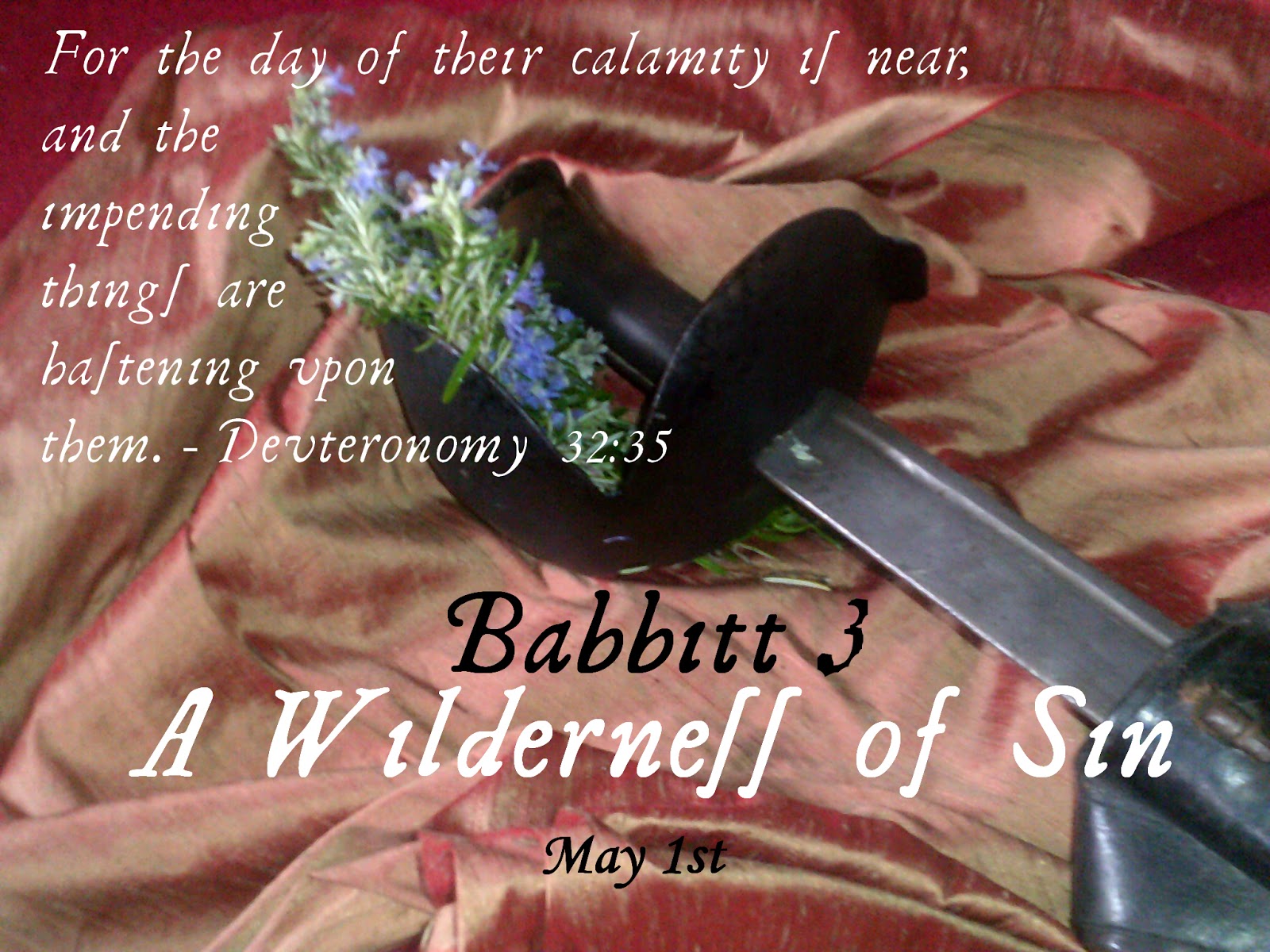
The New One..... Babbitt #3 Out in May!


June 1645

Shattered after their defeat at the bloody battle of Naseby, the King's troops are in disarray, their last hope a loyal Royalist hardcore in the West Country.

Parliamentarian Colonel Hollie Babbitt's troop of cavalry are always in disarray, so he has a degree of sympathy.

But certain members of the troop are hiding a secret, after Naseby - a secret that left the brutal sadist Captain Chedglow dead, Hapless Russell invalided out in Essex under the watchful eye of Het Babbitt, and posh poet Pettitt and fierce, enigmatic Trooper Gray locked in a most unlikely alliance. And they're not telling.

Hollie's too busy wrestling with his own conscience to pay too much mind to the internal politics of his troop, though. The Army of Parliament might be winning the war, but their soldiers aren’t seeing much of the benefits, and there are voices within the Army starting to make petition for the common soldier. And Hollie - partisan, cynical Hollie, who's fought alongside both Oliver Cromwell and Thomas Fairfax, who's always claimed his loyalties lay with himself first and foremost - is beginning to wonder if perhaps he should lend his distinctive Lancashire voice to those petitions. Which is going to make him about as popular as the bloody flux, with Parliament.

Love, in both likely and unlikely places. Death. War. Bubonic plague. Blood. Politics. Intrigue. Transvestite Huguenots, and bad poetry.

Who said the Roundheads were the dreary side?

Thursday, 26 February 2015

A Wilderness of Sin - the Siege of Bristol, 1645


For the full effect, read whilst listening to Bach's "Cello Sonata No 5"
Some names have been removed to retain a degree of spoiler-dom... but really, it doesn't matter who. I just say as shouldn't that it's a hell of  a good piece of writing. I cried writing it, and I cried reading it again,

Prince Rupert was finally brought to a stand at the end of the siege of Bristol in September 1645, and after a brief and ferocious stand-off, surrendered to Thomas Fairfax.

I dare you not to shed a tear.


Hollie sat on the stairs with his eyes closed, feeling that old familiar gritty sting of too many tears under his eyelids. Watching the sun dropping down below the rooftops, covering the city with a kind rosy blanket, and listening to people being alive in the world. About their business - beginning to stir again, after almost a month under siege, beginning, shyly, hesitantly, to be unafraid. Someone singing in the kitchens below and for the lad's sake he wanted them to be silent - how could they sing when a man's wife was dying in his arms? - and then he shook his head, no. The Lord giveth, and the Lord taketh away. Blessed be the name of the Lord.

He hoped the lad was strong in his faith. He hoped the lad would believe most firmly that he would meet her again, in a better world than this, and that it would comfort him in his adversity. Hollie had remained uncomforted in his for the better part of ten years, seeking comfort or extinction by turns. Had lost his hope, his career, his faith, his good name. If it hadn’t been for Het, his bright pole-star, he'd not have come back. The September sunset was warm and mellow now, flooding the landing with a golden tide, and the singer in the kitchens had fallen silent. The city was silent, an odd moment of stillness, almost as if the world were enclosed in a fragile, hollow soap bubble. A blackbird, singing, in an apple tree, the liquid notes falling clear into the dusk.

He could hear the lad, talking to his wife, through the latched door. Couldn’t hear the words. Just the lad's happy, bright conversational voice, talking to himself. Talking to a dead woman who was still breathing. Saying, God willing, all the things he hadn’t had time to say in six weeks of marriage, and should have had a lifetime to say. The lad was barely twenty-two, he was a boy yet, it was wrong that he should be made to suffer so. It was bloody wrong and any God that thought it was fitting to put a pistol ball in the brain of a living, feeling young woman with so many years of useful life in front of her, and then to leave her husband to lie alongside her on a narrow bed in a strange town and wait for her breath to stop - ah, Christ, no, that kind of God was a vengeful arsehole and Hollie Babbitt would look Him in the eye on Judgment Day and bloody well tell Him so, and the hell with the consequence.

It was nothing to do with the lad. He knew that. It was thinking of himself and Griete, all those years ago, that made the tears come again. Thinking he knew what the lad was feeling, though he didn't, God knows he couldn’t, they were as unlike as flint and cheese, but - even so. Hollie knew what it was to love and then suddenly to find yourself cut loose and desperate. He'd not let the boy go into that darkness. Not alone.

He put his back up against the door and sat with his head on his knees for a while, listening to his own breathing. Thinking of his own girl. Loving her twice over, loving her for that other girl's sake, for still being alive to be loved while the other girl was leaving this world. Crying again, silently, for he had no right to mourn another man's wife, but he mourned the loss of the lad's first love and the his innocence and, for a while, his joy, and that was a death in itself.

He'd miss the daft, dreamy little bugger. He could only hope the man was one day going to be as full of hope and dreams and cockeyed romanticism as the boy.

The moon was rising. In the room behind him, the lad's voice was growing hoarse, but still steady, still constant. Worn out with war and grief, Hollie slept, with his naked sword to one hand and one of Het's faded silk ribbons clutched like a child's comforter in the other.

It was shortly after dawn the next morning when the lad opened the door. Pale, but neat and dry-eyed and calm "She's gone," he said softly. "Would you be so kind, sir, as to fetch - fetch your father?" .

Awarded for Excellence in Research by 17th-Century Specialists

Awarded for Excellence in Research by 17th-Century Specialists